Suburban fruit trees are for the birds

I planted a nectarine tree in my garden and regretted it almost immediately. It turned out to be more work that I thought. No-one told me all the fruit would ripen around the same time. I’d go from nothing edible to a glut of hundreds in days. You can only eat so much fresh fruit and make so many jars of chutney.

Fruit fly are a headache. Almost impossible to control, they can ruin entire crops of thin skinned fruit like the nectarine before it’s ripe. It’s an eternal battle, the pesticides are all (rightfully) banned, baits are useful only to a point and netting is a big job. But you have to keep fruit fly under control or they spread over your fence to your neighbours and infestations get out of control. I end up taking most of the fruit off and binning it while it’s not much more than a twinkle in its mother’s eye.

Every year, I wonder if it’s worth the trouble. Think about pulling it out and planting something less needy.

Then it blossoms. And I’m back in love.

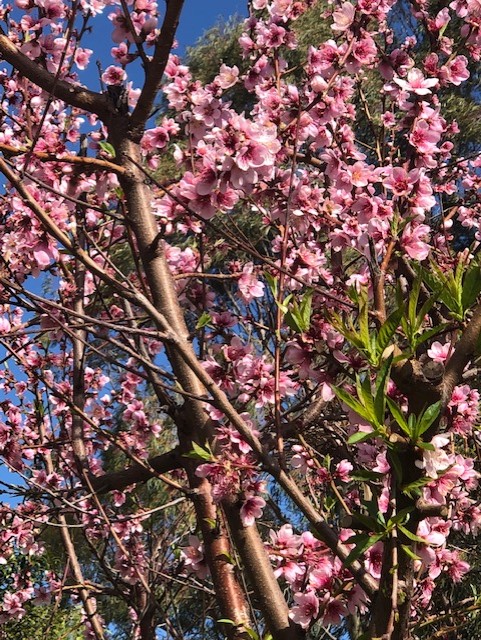
It’s not just the mass of glorious pink flowers that crowd the view from my loungeroom window. It’s the variety of life that descends overnight and the soap opera that ensues. For the short time it flowers, it’s a riot of birds and insects, either oblivious to one another or bickering delightfully over the booty on offer.

There are hundreds of bees every day, too busy to care if you stalk them, you can get close enough to count the veins that thread through their clear wings and see the glassy membrane turn to rainbows in thin winter sunlight. Close enough to see shiny black antennae and the bright yellow fuzz that haloes their heads. Among them, small spiders work tirelessly, spinning webs hoping to catch bees and other insects, never discouraged, not even when their delicate work is shredded endlessly by all the other activity.

The birds are especially winsome. I could watch them for hours. I have two striated pardalotes that pop in and out, so small they’re easy to miss but for the cheeky sound of their chip-chip call and their bright white brow against yellow and black plumage. I can walk right up to the tree and they’ll hop nearer and nearer to get a better look, their tiny heads tilted to the side as if they’re as curious about me as I am about them.

The Honeyeaters arrive en masse in the late afternoon, squabbling and shrieking, jostling for position and dangling upside down to bury their thin curved beaks deep into the heart of each blossom. One particularly bolshy bird of the New Holland variety, distinctive with its air of perpetual outrage, arrives early and hates to share. He’s never too distracted or too sated with nectar to guard his stash, chasing off any other bird that dares approach while he’s feeding. It’s like witnessing a particularly persistent Imperial TIE fighter in pursuit of a rebel cruiser.

I love the way these small birds cling to twigs and hop so lightly from branch to branch. If there’s a particularly enticing flower on offer, they hover like hummingbirds, wings a-blur, to get a good angle. They love to dive into the birdbath below the tree and nip back into the blossom to dry off, ruffling up like small wet dogs, into shaggy balls of feathers, tiny bright eyes peering out, ever alert. Then back to feeding with their usual studied intensity.

For these beautiful creatures that can struggle in cold weather, when flowering trees aren’t as abundant, blossom trees can be really crucial food sources. And of course, there’s all sorts of life that thrives on and in the tree that I don’t notice in the same way at other times of the year, but is equally important. And I get so much out of those few weeks when the tree is not simply a mass of stunning flowers, it’s a hive of very visible activity. It’s mesmerising and soul soothing. I try to take photos but you can’t capture it really. You don’t see nature in quite the same way when you’re looking at it through a screen, even on a camera. So mostly I simply enjoy the show.

It’s worth it.

My year of writing dangerously -or how to write fiction when you don’t know what you’re doing.

A few days ago, a Facebook memory popped up in my feed, back when I was shortlisted in a writing competition for the first time. Hurray! It was the London Independent Story Prize in the UK and a piece I wrote about a golden-orb weaver spider. I didn’t win but it felt great. I get the same feeling anytime a fictional piece I have written gets published. I think it’s to do with making something from nothing.

I’ve been writing short fiction for over a year now. For the most part I’ve been feeling my way as I go, learning what I can from people who know more than I do. I’ve had some small successes but the vast majority of my work remains unreadable, well out of the public eye in bulging folders on my desktop or in the many notebooks I have lying around the house. You can’t have too many notebooks. I’ve been crippled by writer’s block and emerged from the other side scarred and fragile. What a ride.

In that time, I’ve met lots of fellow aspirational wordsmiths who want to have a crack but don’t know where to start. Not everyone has an idea for the great Australian novel but there are so many different ways to explore creative writing that don’t involve huge debt or another degree. Obviously there are many, many experts on the subject and I am not one them.

What I do have, is experience in being inexperienced, I remember what it’s like to feel overwhelmed by the weight of my own expectation, deeply shy, with only a vague sense I wanted to try, and no idea how to do it. I have been that new leaf ready to unfurl and turn its tender face to the sky only to be scorched into ashes under the harsh glare of a burning sun so fast, it barely knew it was ever even alive. It’s called journalism. It teaches you how to write tightly, but just as importantly, it teaches you resilience and it was an excellent background for this particular new leaf.

I thought I’d share, a year on from diving in, some of the excellent advice I’ve been given that has helped me as I venture into writing short fiction.

Journalists (hopefully) learn to not take themselves too seriously pretty early on, and I can’t tell you how brilliant that life lesson is generally and when it comes to writing. Take the work seriously, but not yourself. For every time you start feeling too pleased with yourself in a newsroom, there’ll be a sub-editor to wave your carefully crafted copy in the air over their head, (back in the days when we wrote on paper) shrieking WHO WROTE THIS CRUD in front of your colleagues. They’ll summon you to stand over their shoulder as they peer at your story with narrowed eyes, shake their head in apparent wonder such incompetence could exist in a professional workplace, eventually flex their shoulders as if bracing themselves for the Herculean task ahead, and tap out a new version in seconds that makes, you’ll both agree, much more sense. You can’t take it personally. A thick skin is useful in any environment.

Start small if you want. You don’t need to write the world. I wish I could sit down and bash out a novel, have a solid story in my mind and the will and drive to write it. But we can’t all be Craig Silvey. It’s absolutely ok to write for fun. In fact, given by far the vast majority of writers won’t earn enough to pay for a new set of shoelaces you might as well decide to write for fun from the outset, then anything else is a bonus.

Choose your genre lightly. Try some different stuff and see what you enjoy. It all helps. The skills you learn from writing essays, short stories, flash fiction are transferrable. I have never got further than that but I’m going to assume those same skills will come in handy if I do ever decide I have a compelling idea for a book. I love short fiction, for myriad reasons and it lets me experiment without committing myself to a huge project.

Everyone I imagine, goes about it in their own way. Use your computer or try handwriting in a notebook. Keep a journal. Give yourself a time limit, maybe ten minutes, whatever works. I like to write to prompts or tasks. It helps me if someone tells me to write about chickens for example, something in my brain responds well to direction whereas if I am left to my own devices I get a bit lost. You can get prompts by joining a writing group, google writing prompts or advice for writers. There is so much out there when you look.

You don’t need to get caught up writing a complete story to start with. Just get some words out. I like to start with fragments of a memory, then make things up and I don’t stop for anything. You can go back and worry about spelling mistakes and narrative arcs later.

Once you have some words on paper, you can edit. I always start new drafts in a separate document and keep the old version in case I get carried away with my flame thrower and wreck the story. This is why most of my writing is not very good. I keep it all. My notebooks and computer are full of half written stories that go nowhere, a gazillion drafts of a gazillion stories, it doesn’t matter. Editing is so much fun if you can get past your own head telling you every word you write is either a luminous gem to be nurtured at all costs, or the worst thing anyone in the history of the world has written. Neither of these is helpful.

Put yourself out there. Even if it’s just reading a story aloud to a writing group. It’s terrifying but it gets easier. Look for small micro or short fiction competitions like Furious Fiction which is free to enter and runs every month, there’s Retreat West, Reflex and Bath. You don’t need to win, although that’s brilliant, it’s about developing the habit, having deadlines and a purpose if you’re starting out and you aren’t really sure what you want to write. I promise it will help you. Join Writing WA or the equivalent in your area to keep updated with competitions and resources and sign up for newsletters or author websites where writers offer tips to help you improve. For flash fiction, my genre of choice, I highly recommend Kathy Fish and Tommy Dean and Matt Kendrick. Also, SmokeLong Quarterly and Fractured Lit have excellent examples of short fiction and great craft articles. Many offer fantastic short courses.

Link up with other writers. Twitter has a terrible reputation for snark but it is a fabulous source of good writing communities. I am in three writing groups, two of them are small with trusted close friends who fill me with joy every time we meet, one is much bigger and I use it for resources mostly, but we all support each other as well. You’ll know a good writing buddy when they offer specific solicited advice that makes your work better and they lift you. Anyone who offers unsolicited negative advice should be crushed under the iron heel of your stony indifference.

Writing is such a lovely thing to do. Don’t suffocate your passion by worrying about having something important to say or even who might read it. You’ll find out soon enough if you enjoy it if your only motivation is the writing itself.

Editing is a process you can learn and it’s a really valuable skill. There’s also lots of good articles and resources online free. Hemingway is one good option.

Here’s some of the editing advice I’ve been given over the last year or so that’s worked well for me.

  • Focus on the first and last lines. Make them really strong.
  • Look for cliches and cut them, find a new way to say what you want to say.
  • Look for filler words like ‘that’ and ‘just’ – and cut them if you can.
  • Look for any words or phrases that are repeated and change them or make sure you know why they belong.
  • Add detail. The more precise the better, smell, sound, a tiny image. A window is a window, but a wooden window where the paint has peeled and the glass is cracked, takes you somewhere specific.
  • Burn your adverbs. Burn them all. If you don’t want to because you are convinced they make your story sound better, try taking them out for fun to see. Then burn them fast before you’re tempted to put them back in. (I think there are 24 in this piece- it could use a good edit.)
  • When you think you have something that’s ok, read it aloud. Print it out. Get the Read Aloud function on your computer to read it to you. WA author, Susan Midalia gave me this advice and it’s a jewel. It’s something we always did at work with news copy or radio scripts, and it works with fiction, you pick up mistakes you don’t otherwise see and it’s a good way to see if your writing is conversational. Changing the font, (thank you Megan Anderson) helps to see your work with a new eye as well.
  • Remember for every rule, there is an exception.

By far the single most helpful piece of advice I have found that I come back to time and time again is this. If you know who said it, I’d love to have the reference.

“You aren’t required to write something good every day, you are only required to keep showing up and hoping.”

Painting: Mavis by Deborah Watt.

‘A Room of One’s Own.’

“A woman must have money and a room of her own if she is to write fiction.” Virginia Woolf.

In all my 54 years I have never had a room of my own. Until now.

I have wanted one all of my life. But there’s always been something in the way. As a kid I shared a room with my sister, to be honest that was harder on her than it was on me. I was messy, she was tidy and her makeshift room dividers consisted, at various stages of our childhood, of a line of cupboards down the middle of the room or masking tape and if neither was available, an imaginary barrier marked out by herself held in place by threats. None of these methods worked for long. We both felt ripped off.

At 19, I had a daughter on my own and not much money to say the least, so anything extra went into trying to give her as much as I could with what I had. I had an old table for a desk in my bedroom but as anyone who has coveted a room of one’s own will know, it isn’t the same. I was working too hard to think about it much.

A proper room of one’s own is more than an area in a house. It’s an attitude, a decision, a philosophy, a political act. It’s making space and time for yourself, having even the most humble of means to do it, without the relentless pressure of something else or someone else being always more important. It is massive privilege on myriad levels. For many women, this is the story of our lives.

So here I am, 54 years old and for the first time I have created a room of my own. How did that happen after so long? I’ll tell you.

First, I gave up my job last year. It was a great job, and I’m immensely grateful, it just stopped being a great job for me. It took all my time, left nothing for my family or my friends let alone myself, more energy than I had to give and I had done it for so long it didn’t excite me in the same way. I had stopped feeling occasionally afraid in that way you do when you try something new and you don’t know what you’re doing. The kind of afraid that reminds you why you’re alive. Which is not to say I had nothing left to learn, I had just stopped wanting to learn that job at that time. I wanted to learn something new. And when a series of opportunities came along to do that, with a small income, not huge by any means, but enough to mean I wasn’t setting my life on fire when women my age are in the fastest growing demographic for poverty, I took it.

Then I started trying all the new things I did want to have a crack at. Some of which made me very nervous. I gave a keynote speech, took some writing classes, wrote some short stories, submitted them, accepted a part time job, made marmalade, picked my granddaughter up from school and took days off to stroll into Freo on a weekday for breakfast, holding hands with my husband.

Another step was a writing competition I won. Hurrah! It paid just under two-thousand Australian dollars and I bought myself a writing desk. It wasn’t an expensive piece, I bought it from a Swedish chain furniture shop but it was mine and I bought it with money I earned doing something I love for no other reason than I wanted to. My story was inspired by my grandma, Molly, who suffered severe depression and died when I was four. She had no room for herself, even in her own head. In a way I can’t articulate, I felt connected to her through this process.

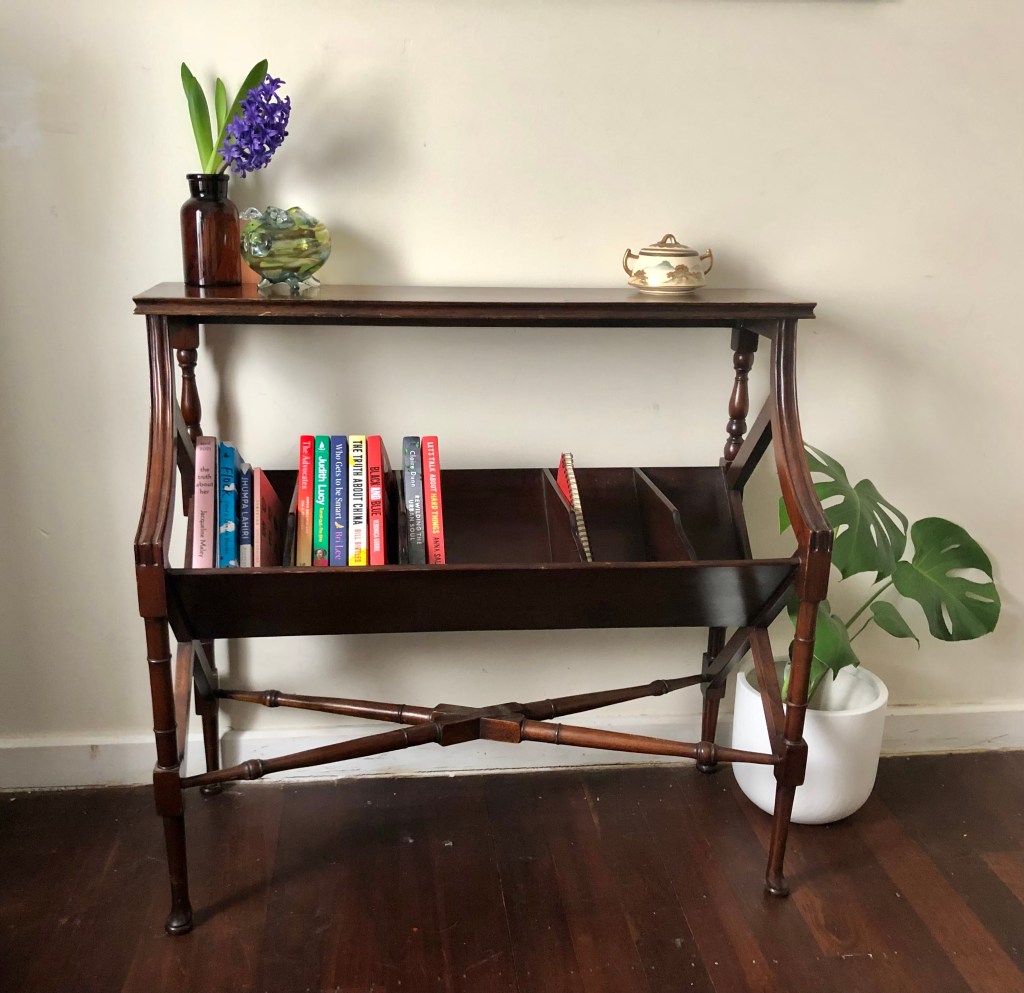
Slowly I have taken over the spare room, and I’ll note again, a spare room and a room of your own have very little in common. I cleared out the junk, put up pictures I love, arranged the furniture how I like it, placed my desk by the window where the northern light streams in, it’s the only room in the house that gets that glorious sunshine. I bought a cheap day bed and a bright yellow rug. I buy myself flowers (the first hyacinths of winter this week) and arrange them in a vase on my desk. And on Monday I drove north of the river to buy the glorious quirky secondhand bookshelf you can see in the picture. A hundred and fifty bucks and I did not haggle. The fact that my husband looked at me quizzically when I proudly unveiled it because it is not to his taste, only makes me love it more. I love the home we have built together, but I also love having a small place where only my opinion of the furniture counts.

What I have is not just a room in a house with my stuff in. I have taken space for myself. It could be a corner in our bedroom, or a regular trip to the library if needs must and circumstances don’t allow anything else. Even that small shard of freedom is beyond many. The point is it’s deliberate, I can, without apology or explanation, do what I want to do with some of my time. Well mostly without apology or explanation, I am still new to this. Which is not to say being a mother or a wife prevented that, my husband and my daughter are the loves of my life, and would be the first to applaud. Because I have more time in my day for everything I love, it’s been easier to add myself to the list of things I need and want to take care of. And now I’m there, I think it would be really hard to take myself off that list too.

Virginia Woolf in her essay, A Room of One’s Own was making a complex point about women finding their way in a literary space dominated by patriarchy, essentially summed up by that enduring quote above, it’s among the most significant contributions to gender equality in literature. My own particular interpretation here is not an urgent feminist manifesto or anything close but more a quiet realisation and a series of small personal observations I have made in the last year or so.

As it happens, this is the first time in my entire adult life I have have been able to make some big choices based on what I want to do, not what I have to do to get by. The only thing standing in my way now, is myself. I have been interested to see how ingrained old habits can be. And what a difference small changes make. Like buying hyacinths and cheap second hand bookshelves just because I like them. Small things, profound privilege. And a very full heart.

Welcome to our crisis

It’s not so bad in here. I’ll admit to a few existential hiccups. One of them is constantly forgetting we’re in a different world and carrying on for a second like nothing has changed. It’s an odd feeling when I remember a lot has changed. Does anyone else occasionally feel a flash of being in a movie that was written a long time ago?

The thing that weirds me out most is how quickly I seem to be adjusting. I’m not one of those people demanding our governments do things differently. Or writing to newspapers or posting outrage and fear on their Facebook pages or sending home remedies via messenger apps. I’m keen to be quiet and stay small. I am compliant with the new rules on travel and physical distancing. I’m apologetic when I need to poke my head above the parapet to stand too close to people in supermarket aisles or to ask for Ventolin at the chemist where they stress-laugh at me for not knowing they were cleaned out ages ago. There is a lot of stress-laughing going on, I have noticed.

My social media is all about posting my attempts to grow vegetables and uplifting things to read. My online book-club is a haven to escape to after the relentless barrage of news I can’t avoid when I go to work on the radio every day. I’m posting about being kind A LOT. I have become a living meme. I am a poster on your wall of a kitten hanging from a tree by one paw with a caption that says HANG IN THERE.

There is something in me I am only slightly ashamed of, which is ok with having quieter times. The alone times. I am good at this and my life before, just weeks ago was too busy, and too noisy and I kept getting ill because I was running too fast, doing too much, thinking too rapidly too often and full up.

I have wondered, of course I have, if the planet has felt like that too, these last few hundred years since we got a bit too clever for our own good and forgot we are connected to it, that we rely on its good health. I wonder if it feels like many of us do when we have taken on too much, but we don’t know how to stop or what to cut back on because it’s all become too normal, we think we need it. Now, like many of us, it’s sick and gone to bed with a gentle book to rest and rejuvenate and think about making big changes in its life. Who hasn’t considered that maybe we’re the virus, and COVID-19 is some kind of earthy immune system fighting to claw back some room to breathe. Literally anti-bodies.

I have wondered, of course I have, what the world will look like when we come out of this in three months or six months, or a year or more. Will there be substantially less of us? Will our grief cripple us or will it compel us to be present with our hearts? Will the air in our biggest cities remain cleaner? Will dolphins stay in waterways they had abandoned for so long? Will we decide there’s a lot to like about living more quietly? Will we remember the value of community and connection now the gap between the selfish and the altruistic is so clear? Will we stop thinking we can control on our own terms our natural surroundings and realise how utterly connected and dependent and vulnerable we are?

Small things are making me happy in my crisis. I’m re-reading books I read as a child, and I’m planting the off cuts of my kitchen scraps in pots in my garden and watching them grow. I’m particularly proud of my spring onions. Every day I visit the golden orb weaver that has set up an elaborate, glittering web across my back garden. She has chosen her spot well, she has many dinners wrapped up tight and tidy, and hung like a string of beads above her. We call her Mavis, after a song we like. I listen to the small birds shrieking in the trees outside my bedroom window, and it doesn’t escape me they are oblivious to everything but their turn to fluff their feathers in the bird bath.

So, in my crisis, I have learnt some things about myself.

I have learnt to sit with my love for my mum and my dad. I knew it before, of course, but I didn’t think about it. Now I am thinking of it all the time and I’m glad because they’re still here and I can miss them and ring them up even if I can’t go to see them. I’m 53 but I’m still their child and I still look to them both for comfort and find it in their voice. I’ll still be their child when I am older and my face is all deep lines, and my neck is loose and my skin is crinkling on my forearms. I’ll still be their child and my child will still be my child and her children will still be her children and so on. It is as it’s meant to be. I feel that very closely now, and I’m grateful for it.

I am reminded every day that the love of reading is a gift beyond measure and I am as lucky as someone who’s been born with a great talent to have this wonder at my disposal. It’s the comfort and thrill of being wrapped in an other-worldly cocoon crafted entirely and uniquely by the author and me. Together, with their words and my surrender, we spin our own magic never to be re-created in exactly the same way again, even when we read a book twice.

There’s something special right now in the physical books of my childhood. I have once again picked up my old copy of Anne of Green Gables. I found it originally in my own mum’s bookshelf as a kid and adopted it as my own, so I don’t know how long we’ve had it. My copy is tattered beyond being even vaguely readable to anyone else. Its spine is cracked, it’s heavily stained from age and years of eating vegemite toast and drinking milo while reading, whole passages are obscured but I have read it so often it’s easy to fill in the missing bits. Some of the pages are torn from an unfortunate habit I had as a child of absent mindedly tearing off the corners of books and eating them while I read. No I don’t know why either. There is so much love in this one book, of the story, of reading, of my warmest, safest memories as a deeply introverted child. I could not love it any more than I do. If I were a book and not a human being, this one reflects the most of me. I am keeping it by my bed.

I am appreciating the sense of my husband in our home and the feeling of peace that gives me. Even when we are not in the same room, his presence changes the air somehow to something warmer than when he’s not here. I would say, if I wasn’t thinking about it, that I just like it better when he’s here. I would say when he’s not here I can feel his absence as something missing and not right, and I don’t sleep well and I don’t relax in the same way. Even though I need to be on my own quite a lot. Even though I often crave silence. I think I’ll go and give him a kiss on the top of his head right now. (I did, and he was a bit puzzled if I’m honest. I probably did it intensely.)

I would not diminish what’s happening right now in the world. I’m afraid. My chest feels tighter most days, and I’m joking but not really with friends about what to do if we’re dying and there are not enough ventilators. I’m worried about those who are doing it very tough right now and those who find themselves unwillingly on the frontline. Those who have lost their safety net and those who never had one. I’m trying not to succumb to an urge to check if toilet paper’s back in the supermarket even though I have enough.

I’m also holding on to the deep belief that kindness gives you strength and the more tightly you cling on through fear the less secure you become. I think when we come out the other end of this, whatever that looks like, we will want to feel we were kind when we could be and that we looked for opportunities to show one another compassion. We will want to feel that we did our best.

That’s week one.

(pic: Chris Downey)

How to poach a perfect egg

IMG_5826

Skip to the bottom if you want to get right to what is seriously the easiest and fastest way to poach an egg. 

There’s a ritual my husband and I keep to without fail, as we drive into work on a Monday. It generally follows a weekend of excess, too much wine, too much cheese, too much sitting around, resting our over laden plates on our pillowy rolls of belly fat.

Mondays, as we fly up the freeway, bound for the city, a new week and a new attitude, we plan our healthy life from now on. We plan our financial health in a series of money saving goals, we plan the exercise routine that this time we’ll stick with and we plan above all our new diet which will be both nutritious, fabulous and also involve throwing out less food, so good for our bank balance and the environment. Win!

We don’t plan to plan, it’s just a natural progression of guilt and good intentions.

Obviously, nothing much gets followed through or it wouldn’t be an ongoing ritual. We’d have something else to talk about. This keeps us bonded. The couple that fails together, stays together.

There is one small, exciting area of self improvement though where I have managed to make a dent in my complete inability to either motivate myself or follow through on a well-meaning lifestyle change.

And that is the work lunch. I don’t get a lunch hour, so I have no time to faff about and I hate spending money on it. Last week during one of my regular memory lapses, where the lunch I had carefully compiled from left overs from the night before was left sitting on the bench, I found myself yet again paying eighteen dollars for a salad and a shred of schnitzel at the cafe down the road from work.

I resent it.

I’ve added up what I think it costs me, allowing for holidays it’s about two and a half thousand dollars a year. Money I could spend on a gym membership I’ll never use.

So I have several tactics for avoiding buying lunch. One is aforementioned leftovers from home. Much cheaper, even given the cost of the multitude of expensive eco-friendly containers I buy to pack my lunch in then lose. But that involves cooking to have leftovers to begin with and sometimes I can’t be arsed. Spending too much money eating out is one of those issues that comes up most Mondays.

Another tactic is making lunch at the office.  This works pretty well. I have favourites but they’re mostly not as good as stuff I can buy, so I’m easily swayed by take away options.

But just this week, I stumbled on to an excellent and delicious option for making lunch at work. I’m so thrilled with it, I thought I’d share it. By ‘stumbled’ I mean I saw my colleague, social media editor Adam Ballard do it and copied him.

All you need is eggs, a microwave, a deep bowl, access to hot water and you have yourself the makings of microwave poached eggs.

Now if you have ever tried scrambled eggs in the microwave, you’ll rightly scoff. They’re do-able just not very nice. If you’ve ever been the victim of an exploding egg in the microwave then you’ll rightly be afraid. An egg exploding in the microwave has the force of a small grenade, can cause nasty burns and a very large mess.

I have cautionary advice on that to come.

Unlike microwave scrambled eggs which are ok but not great these poached eggs are as good if not better than you can make on the stove. And I say that not as one of the multitudes of those who can’t master poached eggs and have given up, I can make poached eggs on the stove and I still think this method is superior.

Here you go.

Microwave poached eggs. 

Fill a deep cereal bowl about two thirds full of hot water. Not boiling, not lukewarm but hot.

Crack in two eggs. They should be well covered by water. At least two inches.

Cover with loose microwave lid.

Zap for two minutes. Check. If not quite done, zap another 30 seconds. Check. Tip off most of the water when done and scoop out eggs.

Allow for a bit of trial and error around the quirks of your own microwave and the size of your bowl and suchlike. Don’t get cocky and zap for two and a half minutes because that’s the fast way to egg bomb city.

So easy, so delicious, so handy at work. No salt or vinegar or whirlpools required.

Observe in the pictures, my very first attempt at home, plus a handy pictorial indication of the size of the bowl I use, including a teaspoon for perspective. I fill this bowl two thirds full.

Having mastered the marvel of the microwave egg method, I can feel I am one step closer to a banging new hyper healthy me. And my contribution to the Monday commute conversation this week will be nothing short of electric. You’re welcome.

On the forest floor

IMG_5207

“Grief grinds slowly, it devours all the time it needs.” Long Witt Woon: The Way Through the Woods.

Five years ago my friend died.  Not without notice, but it was fast and I felt riven. I’d lost good friends and family before and grieved desperately for them, then and now, but this loss blew me sideways in a different way. It wasn’t just about the death of my friend, it changed who I was and how I saw the world.

I sank into something more than sadness. I suppose it was depression, the pointlessness of existence was suddenly overwhelming and inescapable. Any existence, not just mine. I obsessed over the impending death of everyone I loved, in a kind of lackluster way. The world revolved around the truth of endings and the nothingness that followed.

People going to work, parents playing with their children in the park, even birds squabbling over the pecking order in our birdbath, I would watch them idly and wonder why they bothered. They were all just passing time.

It was hard to get past.

I envied my friends who believed in a god, because I imagine whatever the failings of its institutions, if you’re on board with that kind of stuff, religion gives you purpose, comfort and community. I just couldn’t manufacture personal belief on the basis of personal need.

I envied my mother, who was also grieving, but she’s a hippy so when there’s a death in what she calls her ‘gypsy circle,’ she doesn’t feel they’re gone in the same way.

“He’s still here,” she would chuckle, dragging happily on a cigarette, at the memory of how during their own long friendship they would bicker for hours about past lives and reincarnation. He thought she was very weird but begrudgingly adored her anyway.  She thought he was equally deluded as a result of something inflicted in this or another life.

I on the other hand didn’t believe anything except he was gone. I was so sad. He was so absolutely gone.

Worried, my husband took me to Pemberton, a beautiful small town in the south-west for a holiday, where he felt the old growth forests would soothe me. We walked everyday, down long gravel tracks. We walked through the tall trees, climbed through scrub and clambered down narrow paths that led to hidden misty lakes. We turned our phones off and played scrabble at night and watched birds hop among the grasses and shrubs outside our cottage in the morning. But most of all I felt peace when I was deep in the heart of the forest.

The air smelt of earth and home, the trees towered protectively around me. The ripple of birds as they moved among the trees, the whisper of wind through leaves, the crackle of an unseen creature crawling along the forest floor, sounds that were welcome rather than the assault I had been feeling in the city. Our footsteps fell in with the natural rhythm of the forest and I began to breathe a little more deeply.

Slowly, something happened that had not happened in any of my previous visits.  I found myself staring more and more at the ground. I noticed, with a sense of  interest that grew to wonder, the mushrooms and fungi that lived there. So many varieties, tiny yellow toadstools, bright and clear as a sour sally. Huge flat plates of fungi jutting out of random tree trunks. Brown fancies frilled like a Victorian lady’s nightgown, small red caps with white stems like you read about in fairy stories as a child.

The more I looked the more I saw. We walked past trees that stretched to the sky, in their prime. Breathtaking in their reach. But it was the old and the broken, the long dead stumps too wide for me to put my arms around that I saw now.  Fungi was everywhere. At every stage of life, small and easy to miss on the side of a 60 foot marri tree, dotted among the leaf litter on the forest floor, smothering fallen old trunks in bright green moss, drawing them slowly, slowly into the ground. And all around new life was springing forth, fed by those that had come before them.

The process was beautiful. I started to feel an almost spiritual connection that I didn’t understand and didn’t need to, because it was speaking to me at a level deep beneath my skin.

It was different to my mother’s surety that in death my friend still existed somewhere as I knew him, but it was comforting, because it felt real and it took me out of myself. Everything spiritual that made sense to me in the past, about striving to ultimately release ego was here and happening all around me. Quietly, slowly, inevitably. But not without purpose. The idea the essence of everything would eventually be absorbed into the earth illustrated to me, profoundly, how we are all connected.

It didn’t make me less sad, but it did help the pointlessness that was crushing me.

And I began to heal. I went home. I forgot a little about my mushrooms and stopped staring at parents pushing their child on a swing and wondering why they bothered.

Now five years later I have picked up a book. An epiphany in itself. And a reminder.

The Way Through the Woods; of mushrooms and mourning is written by a Malaysian writer, Long Litt Woon, who went through devastating loss when her husband went to work one day and didn’t come home. She describes her own understanding and relationship with death and grief and she talks about how she found her own way back to life through fungi also. Long Litt Woon’s passage through loss led to her becoming a student of Mycology, the branch of biology concerned with fungi. Her book is both a study in grief and healing and an exploration of this incredible form of life we still know so little about. Science and what it means to love and to be human all rolled into one.

It’s magical. I have been reminded of what it means to connect and I have a renewed fascination with these incredible organisms that play such a role in life and death.

I actually don’t think it matters, really, how you find your way back to connection after loss. I know many don’t like the idea of comparison and will say it’s relative. I’m sure it is but I would not compare my loss with a woman whose husband died. That is just more.  I can only speak for my own experience.

There is, for me, a deep selfishness that overcomes you when you grieve. Not the kind you choose where you take the biggest piece of cake or steal someone’s carpark or don’t appreciate your loved ones. This kind of self absorption is involuntary and suffocating. You lose the ability to connect with anything but how you feel at that moment and how you think you’ll continue to feel tomorrow and the next day and the next. Grief makes its home in your chest and it’s heavy, so even something as natural as breathing becomes an effort. The worst of it is the loss of connection. To anything in yourself other than your loss, to anyone around you. You feel utterly alone.

Nature has a gentle way of reminding us that you are not. That everything is intertwined and you are a part of something bigger than yourself. It’s mystical, peaceful and deeply healing.

To me, it was something as small and as vast as a mushroom that led me back to connection. I still miss my friend. His name was Niall.

Long Litt Woon’s The Way Through the Woods, of mushrooms and mourning,  is published by Scribe. She is coming to Literature and Ideas for Perth Festival in February 2020.

IMG_5426

(photo: Albert Shaart, Flickr)

The magical friend connection

IMG_3978 (1)

The fact is that a woman friend is as rare as a true love’- Elena Ferrante.

When I was a child, my mum had a very beautiful friend. She was exotically Irish with an accent. She was fashionable and had a name I’d only ever seen in a book.  Her home was filled with all the things I had long felt sure would transform my life if I was lucky enough to acquire them, i.e. things I’d seen on tv.

Continue reading “The magical friend connection”

I remember you

IMG_2819

I remember you.

You intruded with your hippy music, weird food, your big orange pots and harem pants. We had each other’s measure. Enemies at the gate.

You were thin and pale with way too much hair, not like my dad. I wanted to blow you away, out of our house, down our street, back across the river where you came from. I waged a long campaign to drive you out.

The stand off over my cat which you wanted to give away before you moved in, burning sticks from the fire offered as sweet treats, with smiles that didn’t mean it, while we stared the other down.  Lining the pockets of my dressing gown with paper towel before dinner, so I could squirrel my food away for later after I’d provoked you into sending me to my room. The shameful lies I told my mum about your children breaking my stuff so she wouldn’t like them. How much it hurt when she knew I was lying and took their side.

You stayed.

So did the cat.

I don’t remember when we became friends, how we picked our way through the spiky path of mutual antipathy and found a way to love. Neither of us were good at it. We both recognised that much at least. Maybe that’s how.

I remember your kitchen and the food you made, nothing like the food I knew before. Ratatouille, coarse brown bread we had to slice ourselves, made into chunky croutons fried in olive oil when the bread got stale. I remember your aubergines and avocados, the beer you brewed in big brown bottles that were stacked in the pantry. The white parcels of bacon scraps we bought from Watsonia on High Street for five dollars and had with eggs and mushrooms on Sundays round the table, all together. I remember your stance on the evils of soft drink, which you demonstrated with a dirty silver 5 cent piece in a glass of coke on the fridge. The coin came out sparkling clean after a few days. I got the point but I still really wanted to drink the coke.

I remember your music that filled our house. Your record player with the good speakers, the real diamond needle and the blue velvet cleaner in its rectangle box. The shelves of albums in their covers with the plastic sleeves intact because you were careful about that sort of thing. Side by side, all in a row, their colours like a painting. We would play them every night at dinner, and all weekend. We’d play them on Saturdays while we cleaned the house, each taking turns with a room, week round. Mine was the kitchen which meant scrubbing your big wooden chopping board with the round cut-out for scraping food into pans and putting your knives back into their right place in the block. Or the lounge-room which meant dusting mum’s ornaments, chopping the wood and filling the wood basket for open fires on cold nights.

I remember you.

That time you and mum smashed the plaster off the wall along one side of the hallway and into the lounge, leaving the limestone bare. You had t shirts wrapped round your head for the dust. You used sledgehammers to break up the concrete out the front as well. I walked past with my friend from school and pretended it was not where I lived and you and mum were not my family. We weren’t like other families. Not like my old family.

I knew to my great concern you grew dope plants out the back near the chicken run and smoked it with your friends. I disapproved deeply. I did not know that elaborate glass contraption you kept on a shelf was bonafide smoking paraphernalia so I used it to water the plants and didn’t know why you thought that was funny.  I left the anti-drug leaflets they gave us at school all over the house hoping you would see them and fix your ways. You wondered aloud where mum found me and whose child I really was.

You’d surprise me now and again by getting me completely, even if you thought I was ridiculous. You’d smile at me with your pale blue eyes and I loved the light in them. I loved the way you laughed with your whole face.

That time you and mum pretended to be normal just for a night. You did that for me because you knew how much I wanted it. I had started at a different school and brought new friends home. I planned the event for days. I took great care to manufacture a scene from the family I thought I wished I had, and what it might look like. You on the couch with your newspaper, mum at the stove stirring the spaghetti sauce, looking for all the world like she had cooked it and not you. My friends round the dinner table, with a tablecloth and napkins, making conversation. You sat so well with your paper and your proper shoes and jeans instead of the harem pants you liked to wear around the house. Your friend with the wild eyes, wooly hair and bushy beard wrecked our efforts, when he burst in shouting for me to roll him a joint, he was joking of course but my fragile fiction was broken. I cried all night in the garden and you didn’t laugh at me then. You understood. And as it turned out, my friends didn’t mind and my life wasn’t over. And I loved your friend with the wild eyes, wooly hair and bushy beard, and love him still.

I longed for a mum and a step dad who went to parents’ night. I wished we had an iron and our school shirts were white and pressed like the other kids. I wished we did not dig up the hills hoist and use daisy shrubs we planted in its place to dry our clothes instead. But on weekends we’d do something magical like fill the car with helium balloons and release them from the tallest hill in town and then have fish and chips.

IMG_2867

I loved our Christmas where you would dress up in mum’s red caftan and the house was strewn with tinsel and we had a real tree with prickles that smelt like a story book Christmas. I loved our family dinners where everyone was welcome, and there was always enough, whoever arrived. You would talk to us sisters, all four of us like adults and we would discuss real things like music and news of the day. You made me want to be smart, and informed and a good conversationalist. I didn’t tell you I was frightened Reagan would push the button and worried we’d all die from ruining the atmosphere with chlorofluorocarbons. I still enjoyed the chats. You taught me to play chess and card games like Find the Lady and Euchre.

You gave me the playlist of my life with your music. Songs I can’t hear without being with you still. I’m glad we have that, and it can’t be taken.

Sleep well. I’ll remember you.

John Lennon: Imagine.

Murray Head: Say It Ain’t So Joe.

The Eagles: Hotel California.

The Beatles: All of them, but mostly Sergeant Pepper and The White Album.

Supertramp: Crime of the Century.

Bob Dylan: Masterpieces.

Bob Dylan: Pat Garrett and Billy the Kid. 

J.J Cale: Naturally.

Cat Stevens: Tea for the Tillerman.

IMG_2873


When life gives you lemons

thumbnail_IMG_2487

In the continuing saga of my life providing too few lemons or too many lemons, I find myself facing the latter dilemma. It’s a definite improvement.

But still, I have a LOT of lemons and I’m out of practice. A few years ago now the bloke took to my lemon tree with the pruning shears, much enthusiasm and not much knowledge. When I came out to check on his progress, I found him standing proudly by what was left of my once lush and bountiful citrus. It was a sad looking foot-long stump in the ground with nary a leaf nor a lemon to be seen.

I was thrust unwillingly and completely unprepared into the cut-throat capitalistic world of lemons at a price and the price was ten dollars a kilo. It was outrageous and frankly, UnAustralian.

In the years that followed I have survived on my wits. I considered lemons allowed to hang over sidewalks by careless gardeners fair game. I leaned on family and friends with lemon trees. I snaffled more than my fair share when a charitable soul left lemons in a box on their verge or brought a bag into work. FOR FREE. Fools, they know not what it’s like out there where lemons are traded for souls and first borns.

I tried salvaging my butchered lemon, well let’s call it a “tree” out of compassion. And I planted another one because you can never be too sure.

And success!  It’s been a long dry wait, but finally my new lemon tree has born fruit. Has it ever. So many, the tree buckled under the weight and drooped alarmingly to the side. We’ve tied it up with an old pair of tights and I’ve gently pruned some of the more lemony bits of tree back to manageably lemony. Obviously the bloke won’t be going anywhere near it with anything sharper than his wife’s resentful gaze.

I’m juicing a few for later use, and freezing them in ice trays. I’ll preserve some & also having a go at making an environmentally friendly cleaner. I’m on the hunt for more ideas.

The cleaner, which I’m quite excited by, involves peeling the lemons, avoiding as much pith as possible which is a bit fiddly. Then soaking the peel in a glass jar with white vinegar for a few weeks. Keeping it as pith free as possible is apparently important because otherwise the mix is sticky. Hoping it works.

Lemon Cleaner method

Peel 8 – 10 lemons, avoiding the pith. (could obviously do more but once you start avoiding the pith you’ll thank me for keeping your enthusiasm in check. It’s painful.)

Cover with vinegar in a glass jar, and let sit for two or three weeks.

Sieve into a spray bottle, with 50 per-cent lemon mix and 50 per-cent water.

Spray with chemical free abandon.

**********

I will update when it’s done. Meanwhile I’ll continue to hunt out more options to squeeze the very most out of my crop.

thumbnail_IMG_2490


At The Edge

How I jumped off a skyscraper, lost my mind and found it again. An essay on trauma and recovery.

IMG_0867

I always thought the best way to overcome your fears was to face them head on, and in a single puff, like Keyser Soze, they’re gone. They spin away, dandelion seeds on the wind. I’ve since found that’s not always the case. Some fears have deep roots.

On a Sunday afternoon in September last year, I abseiled down a 234m skyscraper. It was a charity event I’d agreed to despite a long-held phobia of high places.
Afterwards, I expected to feel exhilarated, but that didn’t happen. I just felt tired.

A few days later I was walking home from work, one moment I was soaking up some late afternoon sunshine, the next I was crying. There was a surreal sense of disconnection, almost as though I was floating above myself. Thankfully I made it home before the shaking began.

The trembling hit like a train and wouldn’t stop. My teeth rattled so hard I was worried they’d splinter inside my head. It was terrifying.

Several awful days passed where I was sedated to control the shaking. It would pull me out of sleep and strike at any moment during the day, like electric shocks you couldn’t see coming. My doctor referred me to a therapist who specializes in Cognitive Behavior Therapy for trauma.

I was diagnosed with Acute Stress Disorder. It has similar symptoms to PTSD. It’s something you might suffer if you’ve been in a car crash, or a terror attack, an assault or a natural disaster.

I struggled with the idea that I’d brought this on myself, through such a mundane event. I wasn’t hurt, I spent a Sunday afternoon dangling from the side of a skyscraper, securely attached, in no actual danger whatsoever. I found it hard to comprehend my disproportionate reaction. I was embarrassed.

The therapist led me from self-flagellation, which I’ve always had a talent for. I had a horrible phobia of heights to start with, I could barely stand on a chair without vertigo. I spent weeks before the event, publicly building it up, raising money and such so I didn’t feel I could back out. I drove past the skyscraper in question each day and googled videos of past events. My family panicked with me when I told them of my plans, and begged me not to do it. It’s safe to say I was quite worked up.

So much so by the time the day itself arrived, my therapist explained, deep in the instinctive recesses of my brain I believed I was going to die.

I was traumatized even before I’d left the ground, in the grip of the powerful fight or flight instinct I had heard about but didn’t really understand. I know more now. In order to respond quickly to a (perceived) life and death threat, my brain shut down unnecessary activity, like reason. Adrenaline started flooding through me, designed to help me flee or fight for my life. Except there’s another option when you’re cornered. The less well-known F. You freeze. Fight, flight or freeze. I froze.

When it came to the pointy end of going over the edge, I’d panicked, hyperventilated, desperately clung to the metal bar next to me, frantically tried to get a grip on reality. I focused as much as I could on obeying instructions. I was able only to submit.

The shock was extreme, which explained the subsequent feeling of exhaustion. Dozens of people take part in this event every year, and, apart from raising money for wonderful causes, they enjoy it. I’m still not completely sure why my experience was so intense.

I became hypervigilant. Always alarmed. I couldn’t drive, because I was so likely to see a threat where there was none, I was a danger on the road. I found it hard to be around people or noise. Simply walking along a footpath was stressful, because of the constant expectation something might jump out at me. I took to walking compulsively down the middle of the road as though that were normal, up and down my street.

I had awful dreams. Horrors involving my kids being hurt, my dogs or people I loved. I was utterly crushed by any bad news I happened to see. I felt I was drowning. There seemed no point to life, no end to pain. And I was so tired. I was tormented by nightmares in my sleep, I was tormented when I was awake. I recall asking my therapist if having such grim thoughts meant I was as monstrous as they were. It was a bad time, that lasted with varying degrees of intensity for several months.

I felt terrible guilt. We all like to think if faced with an emergency, life or death, we’d fight. We’d run towards the flames, punch the shark, fight off the attacker. We don’t always get to know what we’d actually do. But now I did. I’d go belly up like a submissive dog. What if it had been my child or my husband in real danger? I felt sick every time I thought about it.

They are symptoms, I was told, and there is a comfort in knowing your abnormality is normal, I guess.

I had relentless flashbacks of the event. The metal buckles and steel loops on my harness. The flat grey wall where we practiced before the descent. The scaffolding and pens, where we were divided off, that reminded me so starkly of the pens of an abattoir. The smell of the metal around me. The sense of shuffling backwards, my feet desperately looking for grip, and then that feeling of nothing.

We talked about all of this, my therapist and I. We looked at images of the brain, and lists of common reactions to traumatic stress. I practiced the techniques she taught me, designed to relegate the experience to the past where it belonged.

We talked about fear. To see its profound impact, to appreciate its effort to protect me. To be kind to it, like you might be kind to a child cowering from monsters under the bed. It wasn’t about facing fear and conquering it, beating it into submission or purging it from my heart. It was about acknowledgment and respect. It was about gentle perseverance and repair.

We identified each trigger. My panic attacks were not as random as I thought. We did that by talking and writing over and over about the event, so that I could begin the important process of distancing myself. I began to pick apart a pattern to the stimuli that would elicit a traumatic response. Heights, obvious. Less obvious, the smell of metal. But metal was so strong a trigger that stepping on a drain, or walking too near a wire fence, or even just the smell of metal would spark a panic attack. Knowing why, made all the difference.

We talked about avoidance. When it seemingly made the most sense to shrink from noise and the hidden dangers in smells, tall buildings and crowds, we discussed why it was important to attend to my reaction. I didn’t find this stage of the recovery easy. The instinct to turn inward was very strong, and I resented attempts to peel me away from myself and my vigilance. But I listened because I was desperate. I used the tools I was learning to coax my brain back to reason, even as it fought me.

We practiced exposure therapy. Once I knew the triggers, I could work through them one by one, until they began to lose their impact. I found places in the city, metal places, high places, crowded places, approached them with care and systematically worked through the simple techniques I learned to calm my brain.
It got easier and easier, until one day I stood on a giant steel bridge, high across the river, I faced away from the water, gripped the edge and tipped my head back. I was fine. I was rewarded then with a sense of exhilaration. I didn’t care that I must have looked a sight.

I went back to work, worried that I might not be ready, but it actually helped immensely to be busy. I simply didn’t have time to obsess. It anchored me. Routine was important.

The condition all up had me off work for two weeks, although it felt like a small lifetime, unable to drive for several months and in therapy also for several months. But I was able to recognize my symptoms on my own, and I had tools to deal with them. I was aware there may be tendrils of trauma that went deeper than this one event, that might further explain my extreme reaction, but I wasn’t interested in peeling back the layers of my past in endless soul searching. This was enough for now.

Almost a year later, I’m stronger than I was before, even as I’m more aware of my own vulnerability. I know we can’t ever entirely shield ourselves from trauma. There’s a lot in life we can’t control. But I feel better equipped to get through another sideswipe, should that come. Even if it took time, I could walk myself through recovery, if not on my own, with help.

I am very aware how privileged I am, to have somewhere safe to be, people who love me and a workplace which supported me while I was ill. I’m lucky to have a family doctor who would see me at short notice, and to have so quickly found a therapist I trusted. All of these things were crucial. I know the longer this condition is left untreated, the more complex it might be to untangle. The brain is a powerful organ and instinct is a formidable thing.

I think, in my experience at least, fear is a bit like grief. However unpleasant, it’s not something you get rid of, the idea of closure seems ridiculous. It’s a part of me and, like grief, I understand why. We wouldn’t grieve if we didn’t love. We wouldn’t fear if there was nothing to lose.

  1. IMG_1022

Recommended reading: Matt Haig, Notes on a Nervous Planet.

LIFELINE: 13 11 14
BEYOND BLUE: 1300 22 4636