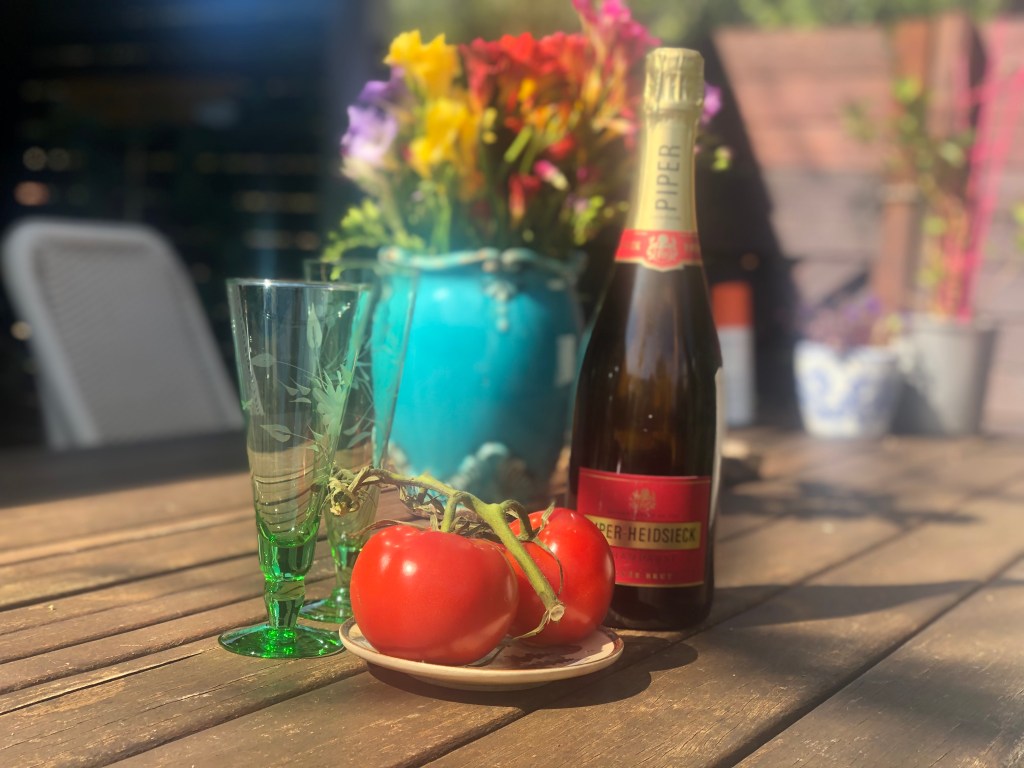
The good, the bad and the ugly

It’s been a bit of a week. We left the city and our beautiful bright apartment in the old centre of Montpellier, arrived in the Pyrenees ready for our rustic, rural retreat and things have not gone entirely smoothly.

We had lots of plans to farewell Montpellier. We loved it there so much. We envisioned something romantic, like champagne in the park or wandering soulfully around the Antique Quarter, or perhaps a glass of rose on the Place du Marches Aux Fleurs. We end up carousing instead, late into the night with four new French friends we met by accident after stopping for a quick one at a local bar a thirty-second walk from our flat. They were generous with their company and their wine. And they loved Jimmy Barnes so were delighted to meet Australians and bond over pub rock. We staggered home around two in the morning after doing shots and singing Working Class Man and other classic Cold Chisel hits loud enough to rattle the shutters all up the Rue L’ecole. So our last day in Montpellier was not spent wafting wistfully around favourite haunts. It was spent lying in bed, holding our heads, emerging gingerly in the late afternoon to stuff four months of accumulated belongings into two suitcases and clean.

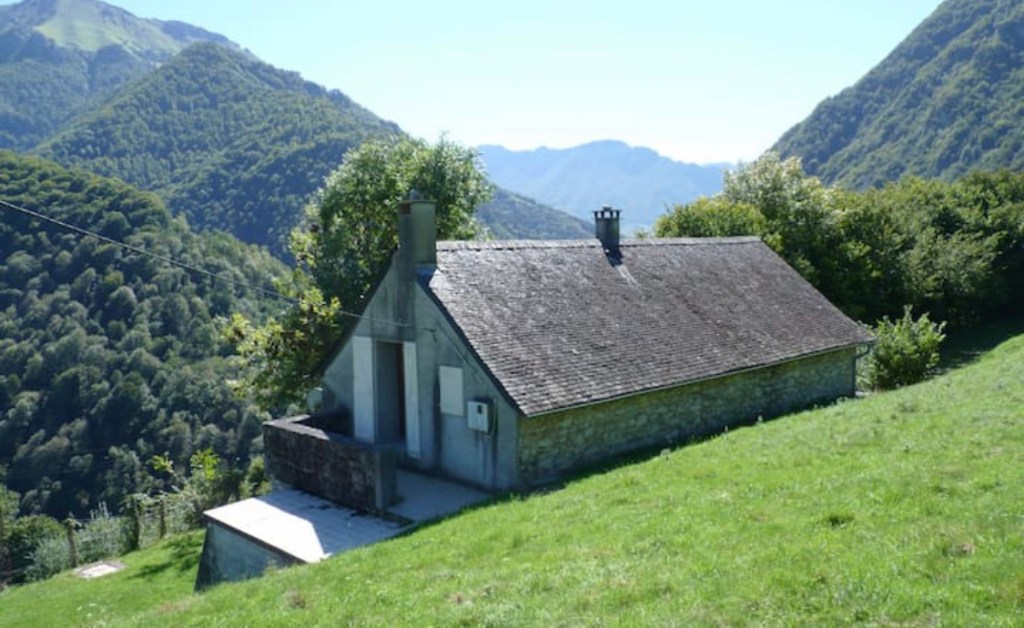
Still, when we left we were looking ahead, not behind. We had eight weeks booked in the Pyrenees, in a rustic gite perched on the side of a mountain near Sarrance, about an hour’s drive from the Spanish border. No plans except walking, reading and watching the day go by on the terrace. After four months of work and travel, we are both happily exhausted and ready for a big shift in lifestyle. This is why we came away, it’s all been leading to this. When we left Fremantle, we were heavy with grief after the death of our beloved labrador, Huey, burnt out, and excited to travel, explore and have a proper break at the end of it. Glynn’s work has been fantastically successful, we have been to Scotland, Norway, Germany and France and had an incredible time. But now we needed to switch off, rest and let the views and the mountain air soothe our ragged souls before we leave for home and get back into the usual routines of life.

We arrived in the Pyrenees slightly bug-eyed with tension from the six-hour drive there. Glynn is yet to get completely comfortable with driving on the wrong side of the road and I am yet to get completely comfortable with watching him learn. Especially when it involves skidding precariously around vast drops on mountain passes so narrow and steep even the goats look nervous. Or squeezing through tiny roads that wouldn’t pass as laneways at home, trying to avoid cars, trucks, and the occasional tractor careening gaily around with the easy insouciance of those who grew up in these parts. All right for some. I left some of my heart in Montpellier and the rest of it was now in my throat. Full marks to the bloke for taking on the driving. If I were behind the wheel, I’d still be curled up in a ball by the side of a lonely French road in the middle of nowhere, crying for my mother.

It was still a beautiful drive, we stopped along the way to stock up on wine and cheese at the biggest supermarket I’ve ever been lost in and we were feeling pretty set to chuck our bags in a corner in our new home, crack open a red and settle in just in time for sunset over the peaks. The bloke, who has been clinging on to sanity by what’s left of his fingernails for some time now is beside himself with anticipation of a glorious and restful mountain retreat. He instructs me to video our entrance into the property so we can record this glorious moment as a highlight to look back upon fondly in our old age. To remind us of simple times, when life was easy, the days were gentle and the air was pure and fresh and as clean as only mountain air can be.

And so it was. Outside. Inside, things were a little more rustic than we planned. We opened the door and were thrown back several paces from the force of the thick cloud of dust that billowed out. We clasped our shirts to our mouths and noses in a vague effort at self-preservation, coughed and peered tentatively inside to be knocked sideways again by wave after wave of a deep and vicious must that screamed from within like a host of trapped banshees, released at last. This place had clearly been shut up since last summer, if not longer.

I opened a cupboard and was showered in a rain of mouse droppings, also alarmingly evident in the ancient toaster. No sign of anything like it in the kettle, because there was no kettle. The ancient oven was coated in thick grime. Every surface was jammed with a motley array of cheap knick-knacks, covered in thick layers of dust and the odd dead spider. We clutched each other in horror and started composing our message to the owner demanding our money back and wondering how we are going to scratch together the energy to find a hotel for the night in the middle of nowhere, let alone somewhere else to stay for two months.

We washed two glasses and dried them on our t-shirts to be safe, poured ourselves two large glasses of wine and escaped to the safety of the terrace.

And we step into the most glorious view. Breathtaking. We see snow-capped peaks crowding the skyline all around us. We are in the heart of the Pyrenees. We hear the river flowing below and the trees that line the lower reaches of the ranges are all colours; dusky purples, palest greens and soft browns. Granite rocks and the winter skeletons of the deciduous trees that line our long driveway are smothered in lichens and mosses. Bright yellow buttercups and riots of small white daisies speckle the grasses outside. Early songbirds are calling and the sound of windchimes turns out to be two belled cows that wander the pastures of the farm below us. Our tired hearts lift.

We decide to sleep on it and see how things look in the morning.

What I’m reading

I’m reading Jenny Colgan, Sunrise by the Sea. This is peak Colgan. It’s about a young woman, Marissa Rossi, who is struggling with grief that won’t heal after her grandfather dies. She moves to a remote island off the coast of Cornwall to recuperate, and meets Polly, who lives in a lighthouse, runs a bakery and has been adopted by an injured puffin called Neil. Marissa’s next-door neighbour is a piano teacher and a huge bear of a Russian who is also running from grief, in the form of a ballet dancer who rejected him in favour of someone more exciting. They bond over Italian food and music. It’s light, charming and easy. A perfect book if you’re looking for something gentle and engaging without being in any way challenging. I love you Jenny.

Switching off

Books. Coffee. Saucepan. Grater. Playing cards.

I’m going through my list of essentials to pack ahead of eight weeks in the Pyrenees in the south of France, where we plan to be mostly offline and almost completely isolated.

It will be the final two months of our six months away and I am ready for some quiet time. We have rented a small, rustic cottage about 40 minutes walk from the nearest village, in the heart of the mountains. We won’t have internet, and at this stage, we’re not even sure we will be able to access wifi in the village.

I’m not going to lie, I’m a little nervous. This part of our trip is mostly about unwinding for Glynn, he’s on long service leave and needs a good break and he’s keen to get back to work refreshed. So the offline bit was his idea. I want to support him, I think it would be so much harder for him to manage if I were constantly ducking off to post or scroll. But I think I need it too.

Even two years out from working in the media full time, I think I am still de-stressing from burnout and online addiction. I still find myself reaching for my phone to check newspapers at least twice a day. My morning ritual is two coffees and four newspapers. My evening ritual is herbal tea and four newspapers. In between that, I check Twitter, Instagram and my beloved Facebook reading page, Reading Between the Wines, email, Whatsapp and my other Facebook pages. I think it’s fair to say it will be good for my brain and my heart to try and have a decent break.

We are only three hour’s drive from Bilbao in Spain, so we do plan to nip over to see the Guggenheim, ( I am just going to pause here and say THAT aloud a few times to let it sink in) but otherwise, we plan to read, hike, amble, talk, play cards and stare at the scenery. I also have grand plans to make bread so if anyone has any recipes, feel free to share them. Especially if you have a recipe for bread in a cast iron pot. I have also bought a box grater so I can make potato rosti, (I just can’t get my head around those flat ones) and I have happy visions of red wine and rosti in front of the fire or on the deck watching the sunset. It’s funny the tiny plans you make when you have visions of a different life.

We have to get ourselves from our flat in Montpellier to the car hire at the airport so not sure the large book stack is a good idea in terms of weight but we don’t want to be caught short and I think I’d rather read hard copy books than my e-book for this trip. We have tried to choose a good range but we were a little limited by the offerings at the local English bookshop. It’s pretty good though! They got me in the new Margaret Atwood in only a few days.

I will miss Montpellier more than I thought was possible. I never thought I’d miss anywhere that isn’t Fremantle. Which I suppose translates to thinking I would never feel at home anywhere other than Fremantle. This is the first time I have ever ‘lived’ outside my city. Well, there was an uncomfortable few months in a squat in Saint Kilda when I was 18 and rebellious but I mostly sat indoors sulking and refusing to admit I missed my mum so I don’t think it counts. I didn’t travel more than that when I was young, because I had a baby at 20 and I worked. So this is new. And wonderful. Challenging, exhilarating and deeply, deeply interesting. Even when I have been homesick or desperately missing my family or tired or a little over trying to make myself understood in another language, I have still been really fascinated by the process. There is so much freedom to be had in curiosity. And the difficult moments have been so rare. Mostly, I’ve been having enormous fun.

The people here are very friendly. We could not have felt more welcome. I have no idea where the tired notion that the French are arrogant or insular comes from. Obviously you get a range of personalities in every country but I also think some of us born in English speaking countries think we are the only ones allowed to feel pride in our language and our home. When we barrel about assuming everyone speaks English it’s ok but the same assumption made in France is arrogant? Yeah, nah.

People will literally approach you in public and introduce themselves, invite you to dinner, join you for a drink, offer help, and go out of their way to be completely adorable. I feel like we have made friends already, and that if we were to settle in France, we’d have no trouble fitting in. It’s a gentle, beautiful vibe. Unless of course, there’s a strike or a protest, in which case, it’s feisty as you like. I love it. I love the fierce defence of rights. I love that half the shops in town are closed on Sundays and Mondays because people want to spend time with their families. I love they are holding on hard to the right to have a life, to retire in their early sixties. I wish there was more of it in Australia.

I do feel extremely grateful for the chance to live my own life now. I can’t wait to curl up in the country with my bloke. I feel so lucky that we have been able to spend this time together already, four months of seeing each other every day and we are still excited to cut ourselves off even more from other people and hang out alone. I don’t really know what to expect. Maybe we’ll hate it. Maybe we’ll hate each other’s company. Maybe we’ll be bored in a week and creeping off to civilisation but we’re going to give it a shot.

I’ll let you know how it goes! If we fall off a ravine or get eaten by bears, know this. We’re ok with it.

Just kidding. That would really suck.

Au revoir Montpellier, merci beaucoup et bonne journee. Tu es la plus belle ville. Je t’aime.

Highway to flamingo zone

Oh, my HEART. I have seen FLAMINGOS. They are GLORIOUS.

And I tell you what, it was a palaver all round, it nearly cost me my marriage and my sanity. But worth it.

Just two weeks ago, we had a disastrous trip to the Camargue in the South of France, near Arles. In as much as a trip anywhere in the South of France can be disastrous – as in not even a tiny bit – but I was tetchy about it at the time. Flamingos are native to the area, in summer there are flocks of thousands and thousands. They migrate in winter but there are some that stay year-round because it’s not that cold these days. But this isn’t summer and I wasn’t going to be here in summer so we went anyway. Even one flamingo would be fine with me. My whole bird-loving life has led me to this point.

I had spent a small fortune on a camera with a built-in zoom lens because they’re shy birds, like most, and they don’t come in that close to shore. We booked a hotel, hired a car to drive to the Camargue. Side note: is there anything more stressful than hiring a car in a foreign city, where they drive on the wrong side of the road AND you have to start the car with an app on your phone AND you have to find your way around a city relying completely on GPS AND you’re running out of phone charge AND petrol at the same time…well…ok, this is a rhetorical question. Is there? No. There isn’t. It is a testament to my marriage that we survived the trip. There was shouting, gritted teeth, white knuckles and eyes bulging with tension, a lot of WHICH WAY, WHICH WAY and I’M TRYING, I’M TRYING and OH MY GOD WE’RE GOING IN CIRCLES and DIDN’T WE JUST PASS THAT BUILDING and STOP SHOUTING AT ME and I’M NOT SHOUTING, YOU’RE SHOUTING and a moment in a carpark at the end where we ran into each other’s arms and leapt about crying and laughing and hugging like we’d narrowly escaped the apocalypse. Want to test your relationship resilience? Or your personal resilience? Rent a car in a foreign country.

Anyway, Arles was gorgeous and the Camargue is divine. It’s a UNESCO-protected area of hundreds of kilometres of salt marshes and lagoons on the Rhone delta, home of the famous Camargue red rice, the “wild” white Camargue horses, bulls and flamingos. We hire a guide and are thrilled with our luck when we find we are the only couple on the tour because of the time of the year. We are not very fussed to learn the wild horses of legend are in fact only a bit wild, and are actually all owned by breeders. No matter. We, at least, I, am here for flamingos. We stop at a paddock to pat a horse on the nose and I ask about flamingos, before whipping out my camera to get a shot of a rather large water rat sunning itself in the pampas grass.

It’s at this point I realise I have a tiny issue with my camera battery. In that, I forgot to check it was charged. This is evidenced by a large flashing light on the display screen which says, battery exhausted. It takes me a minute or two to absorb this devastating news. Ok, it takes me a good 45 minutes to absorb this devasting news. The bloke, who I should mention has very little interest in flamingos, is as exhausted by this stage as my camera battery. He manfully distracts the tour guide with questions he doesn’t want to know the answer to while I get a grip then resign myself to experiencing the beauty of the region with my eyes rather than through a lens. Tres disappointing. We did see flamingos. I think. There were certainly some pinkish blobs out on the water but they may have been shipping buoys. I take some snaps with my phone camera and that’s that.

On the drive home, when we were still recovering from the trauma of the experience and I am planning our next trip back there, we skirt the coastline near the outskirts of Montepellier. I am gazing wistfully out of the window thinking of what might have been, when I notice out to sea some familiar pink blobs gathering just off the shoreline near the highway. That’s right. Flamingos. Flocks of them. It turns out the coast of Montpellier is riddled with flamingos and we could have simply wandered down for a day at the beach if we’d wanted to see them.

So, armed with a camera and a full battery, I set off on my own today. The Gods of Flamingo Spotting clearly did not intend to make my life any easier this trip than the last. It was supposed to be a fairly straightforward 40-minute one-change tram ride to the coast, but they’re doing a bit of work on the lines, which involved trams that weren’t going where they said they were, replacement busses, more trams and a six-lane highway to somehow traverse.

There were helpers at each stop but they didn’t speak English and I don’t speak French. But I was not going to be thwarted again, so I managed to find my way via the medium of waving my phone map about, broken French, and charades. It was the beginning of a great adventure. I got there at last. Et viola!

I could see across the silver sea, not one but two large flocks of flamingos in the distance. Hundreds of them. But no way to get there. Apparently, the locals aren’t as enamoured with access to the native birdlife as I am and there was no nature walk or bike path or any conceivable way around the shore to get to them. Undeterred I went the other way, around the back of some houses jammed right up against the shoreline. After clambering through old fishing nets, a boggy marsh, knee-deep in rotting seaweed and mud, I found, let’s call them a “flock” of ….. three flamingos! Maybe some teenage flamingos getting away from the olds, or the olds getting away from the teenagers. Who knows.

Reader, I married them. Ok, I didn’t but I did fall in love very, very swiftly.

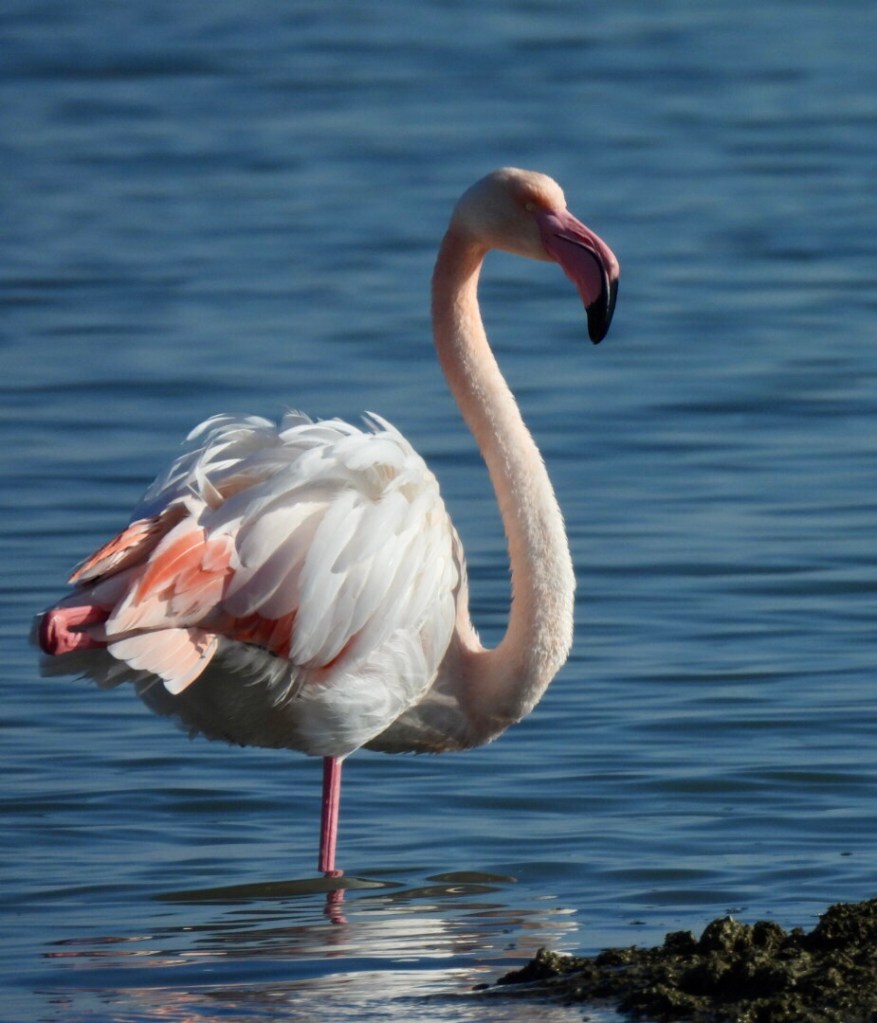
My camera was charged. The light was beautiful. The flamingos were glorious. Oh, you have never seen anything so perfectly delightful. They were an absolute joy to watch. They are cartoonish, elegant, gangly, goofy and all ruffles and beaks, and very, very pink. And white. They wave those long stilt legs around all over the place, I think their knees bend both ways at the joints, I must find out, it certainly looked like it. One of them appeared to be moonwalking backwards for no discernable reason. Another loved to scratch itself above the beak by arching its neck in a kind of reverse loop, then rubbing the top of its head on its back. They are mesmerising. A wonder.

It has been the most wonderful experience. As they say, the journey and the destination. It has been thrilling. I am utterly, utterly dans le rose.

Flamingo facts

A group of flamingos is a “flamboyance.”

There are four species of flamingo, and they are native to the Americas, including the Caribbean, Africa and parts of Europe.

The name “flamingo” comes from the Portuguese or Spanish, flamengo or flame coloured.

Their beaks are adapted to separate mud and silt from what they eat and they use them upside down.

Their colour comes from carotenoids in their diets, which is plankton. The French flamingos are not as red as the American flamingos because there isn’t as much pigment in the plankton they eat.

They honk.

Montpellier flamingo
iPhone flamingo shot in the Camargue

And then I heard the call of home

“Home! That was what they meant, those caressing appeals, those soft touches wafted through the air, those invisible little hands pulling and tugging, all one way.” Kenneth Grahame, The Wind in the Willows.

There’s a scene in The Wind and the Willows when Mole, despite all his exciting adventures with Ratty and Toad and Badger, is unexpectedly reminded of home, and then that’s all he can think of. Badger’s Wild Wood and Toad’s Hall lose their shine. He just wants to go home. He longs for it. But his travelling companion Ratty is distracted by something new and Mole loses his chance. It’s wrenching; both because Ratty realises he’s inadvertently broken his friend’s heart and for the violence of Mole’s grief.

‘I went away and forgot all about it–and then I smelt it suddenly–on the road, when I called and you wouldn’t listen, Rat–and everything came back to me with a rush–and I WANTED it!–O dear, O dear!–and when you WOULDN’T turn back, Ratty–and I had to leave it, though I was smelling it all the time–I thought my heart would break.’

Mum used to read this book to my sister and me when we were kids and I found it completely devastating. It imprinted itself on me as one of literature’s great tragedies at the time, and it has stayed with me. But I’ve had my own problems this week. Overnight, I went from flitting gaily through Montpellier, bonjouring anything that looked in my direction including random pigeons, to curled up in bed wracked with homesickness. I cried. Told my husband I wanted my mum. Cried again. Stuck my head in the bag of lemon-scented gum leaves my sister sent me for Christmas for so long that I nearly asphyxiated. Read old books. Not The Wind in the Willows, obviously. I’m not a masochist.

I embraced the sensation as passionately as I had embraced being a visitor in a new and beautiful city only the day before. But even as I pined, I felt a little bit embarrassed. There’s a kind of insubstantial air to the whole idea of being homesick in my case. I’m not young, leaving for the first time. I have a home to feel sick about, I can leave by choice and know it’s there to come back to. I’ve never been displaced or uprooted, home has never been too far or too dangerous to return to. My daughter is grown up and my grandkids have stopped wanting sleepovers. My husband is here to offer his shoulder and top up my champagne.

Homesickness for people like me, well steeped in comfort, brings to mind insipid things like, ‘having the vapours’. In my mind’s eye, I might as well be wafting about in a tie-dye singlet dress, pining for a pie and sauce, reading Tim Winton wistfully on a park bench, hoping someone who speaks my language will happen by and coax me into a game of footy or pour me a large glass of wine. White with ice, please.

I’ve noticed it doesn’t take much to set me off on a bout of mal du pays. Especially in a new country where I don’t speak the language and people I meet don’t speak mine. The following incidents reduced me to a wreck this week;

  • A young boy working at the supermarket laughed in my direction while I was packing my shopping bags. (Here, clearly I was doing something foolish in his eyes, when I had been trying so hard to either fit in or be politely invisible. What an ill-bred tosser. Laughing at a vulnerable old lady. His mama et papa would be mortified, no doubt.)
  • A woman in a fabric shop emitted a definite air of being annoyed or at least not effusively thrilled to see me when I walked in and wandered around browsing. So much so, that I approached the counter so she wouldn’t think I was a time waster, babbled something and mimed in a kind of hacking motion with my hand – do you sell cheese knives? She said coldly in English. No. We don’t. Which, to be honest, I took as a bit of a slap in the visage. And then when I left I accidentally banged the door really loudly on the way out, so in an effort to be conciliatory I pushed it open and shouted pardon! she didn’t wave or smile or in any way acknowledge my largesse. (Speaks for itself.)
  • The Irish man at the local we have begun to frequent because, let’s face it, sometimes you just don’t feel like trying, politely asked us to sit somewhere else because we were blocking the service counter at the bar. (This was the worst. When one of your own turns on you. Likely he was hoping to insinuate himself into the affections of the locals at my expense. I’m onto you matey.)

The combination of all the above was enough to tip me over the edge. The uncomfortable whiff of someone not too far from where I’m sitting being tres sensitive doesn’t help. It only makes me more snivelly than I was to start with and adds a day or two to my recovery. Someone has to feel sorry for me and I have endless patience for the job.

Happily, previous experience has made me aware I’m vulnerable to both homesickness and a tendency to lean in to even benign misery and I had done some preparation in order to get mon tete out of mon cul. Before it set in too firmly.

Far from my romantic visions of self drifting through French flower shops smelling the imported wattle and shedding the odd elegant tear in response, homesickness makes me nervous as much as anything else. I think I underestimated how tiring it can be to brace yourself for everyday tasks, well, every day. Once the novelty wears off, it gets to be a bit of a slog. It becomes more of something that’s good for me and I have to do, unless of course I don’t want to eat or I’m happy to let my husband treat me like les enfant. So setbacks so minor they could be mistaken for entirely fabricated become wearisome.

I indulged myself with tissues and sleeping in and calling my mum but I also noticed other side effects, nothing fatal, but certainly more insidious. I was feeling anxious about going outside, tackling the tram system, going to a shop I didn’t know, trying to make myself understood, preferring to stay in. The idea of facing the market I’ve shopped at most days, felt, if not terrifying, a bit of a bridge too far. The Post Office, ok, definitely terrifying.

A friend at home, who is very well-travelled, unlike myself, tells me homesickness comes in waves, and just when you think it’s unbearable, it changes and turns into something new. My oldest friend, who has been living in Germany for several years now, takes the same approach. And my mum once described childbirth in a similar way, just before I was going into labour with my daughter, and it helped me then too. If you aren’t managing, hang on for a bit and things will change. There’s a lot to be said for pushing it a little bit. Not trying to do everything, but also not giving in to the urge to do nothing. It’s not about feeling completely comfortable or completely uncomfortable. It’s about trying something small to get going. Even when you don’t feel like it much. Especially when you don’t feel like it much.

So, after a fabulous start to my travels, then a tiny, ok big, bout of homesickness, today has been good. I took the tram for the first time on my own to shop, I had a lovely chat in broken French and broken English with a woman at my favourite fruit and vegetable stall and I braved the dreaded Post Office and bought a box and stamps. Huzzah! I couldn’t make myself understood well enough to find envelopes but to quote the great philosopher, Scarlett O’Hara, tomorrow is another day.

I miss you beautiful Fremantle. I miss my loves, (my other loves). I can’t wait to sit on my back deck at home under a high Western Australian sky and breathe the salted air. It’s where I always feel safe. How brilliant right now though, to be a little scared, sometimes.

“Take the adventure, heed the call, now ere the irrevocable moment passes! ‘Tis but a banging of the door behind you, a blithesome step forward, and you are out of the old life and into the new! Then some day, some day long hence, jog home here if you will, when the cup has been drained and the play has been played, and sit down by your quiet river with a store of goodly memories for company.” Kenneth Grahame, The Wind in the Willows.

Je suis un enfant terrible

Confessions of an unseasoned traveller.

I had all sorts of lofty plans to do more writing when I got to Montpellier, but I have been unable. I have forgotten how to speak English. I even forgot this isn’t new, whenever I go to a country where I don’t speak the language I somehow forget how to speak my own as well. It’s like a syndrome or something. I have stood at shop counters and in bars in countries other than my own waving my hands around and – this is deeply embarrassing, please don’t tell anyone – I have been known to utter the words…’ow you say..’ in a bad accent of questionable origins while searching for a word in a language I don’t know. Like a cartoon version of myself. As though mauling an accent makes me more likely to be understood. It is a testament to the enduring patience of the French people that they haven’t yet cancelled my visa.

It’s not just language, my brain doesn’t work quickly with anything when I’m travelling. I certainly don’t know how to function as a French person and I forget how to function as an Australian too. Small things. I walk on the wrong side of the road and faced with even the slightest hint of someone coming in my direction, I dart in front of them in a panic. I cry in public, as noted in previous musings, overwhelmed with beauty in the form of…. well anything really….small children saying ‘papa’ in French accents, dogs in handbags, anyone holding a baguette obviously, bridges set me off for some reason, old buildings, chefs in aprons standing in doorways smoking cigarettes and scowling. I’m apologetic for taking up space. I wear unattractive shoes.

I am slowly improving. This is after a harsh lesson on my honeymoon in Paris in 2012, learning after a month the mea culpa phrase I was saying to endear me to the locals, Je suis desole queue tu ne parles pas Francais, parles tu Angalis? was in fact informing native speakers of the language how sorry I was that they didn’t speak French and did they speak English? If I was looking for an easy way to make a tit out of myself, I may as well have taken to shouting ‘garcon’ and clapping my hands to get a waiter’s attention in restaurants.

In Montpellier where I have landed with my husband for the next ten weeks, the locals are a delight. People have been so friendly and kind. Not everyone speaks English, or they only speak a little, so I’m challenged a lot trying to bumble through basic life tasks I never have to think about at home. It’s a beautiful city, the Old District where we’re staying is a glorious rabbit warren of rambling, narrow streets that shoot off every which way, seemingly at random. It’s easier to get lost here than in any other city I have seen. After a few days, it makes its own kind of sense and it has a fascinating history that explains the layout of some of the original areas that were built in medieval times. I love it here.

I’m trying to use my best manners. I’m sorry to say it’s my fourth visit to France and it only just occurred to me this week that I might make an effort to find out what might actually qualify as good manners as opposed to assuming I know because, yunno, isn’t it obvious? I started by researching ‘etiquette in France,’ and by ‘research’ I mean I googled so I realise I won’t be getting a Legion d’Honneur medal anytime soon. I did read across many sources that it’s both normal and good manners to say hello and thank you and goodbye, have a nice day, in almost every public encounter, from asking directions to buying bread. I’m also sorry to tell you that in the past unless people were smiling broadly at me and sounding clearly friendly when they were saying bonjour, I assumed they had clocked me as a foreigner and were being sarcastic. But here, even people who look like they’re having a crap day and can’t be bothered with you, will still be polite. It’s shamefully revealing that using basic niceties when you approach a stranger has been a huge revelation. And even for someone who is terrible with language, it’s not so hard to learn hello and thank you.

I’m having a slight crisis of confidence where I’m suddenly remembering many, many instances of appalling manners I have displayed not just in the last week, but in the entire 56 years of my life. My brain may be mostly mush but oddly my memory of my own disgraceful behaviour is sharper than ever. So there’s that discomfort. But I’m also loving it. My life has become so much simpler, really fast. I feel like I’ve regressed to some kind of inner childlike state that hippies I grew up with in Fremantle would pay thousands to replicate. I’m moving slowly, I’m not collapsing on street corners howling into my hanky so much, but I am pausing to appreciate so many small moments of wonder I come across all the time. Things I’d overlook at home because of the familiarity or because I’m busy. I face the day with no loftier intention than wandering through beautiful Montpellier, going to the market, buying milk for coffee and not being an asshole about it. I considered it a highly successful series of events yesterday when I found the local swimming pool, bought a ticket and swam. I had a nap to recover. It was glorious.

So I beat on, a boat against the current of my own ignorance, to misquote F Scott Fitzgerald. The impact of my learning on the lovely people of Montpellier is not completely lost on me, so I’m trying to keep my footprint small and spend my money as liberally as I can afford and as locally as I can. I’m trying to learn as much of the language, even badly, as I can manage in ten weeks. I’m in a lot of uncomfortable situations. But also, I’m having so much fun. I haven’t been so effortlessly mindful in years. Decades. I feel happier, less shy, less fearful. And not in any way that means anything at all to anyone but me, I feel a tiny bit braver than I did a month ago. Although I did just that second have to check if I’d spelled ‘braver’ right because it looked weird on the page.

Merci, au revoir et passe une bonne journee.

Going where I’ve never been

Today I cried in Oslo. I was surprised, and then I remembered that I’d done this before. I’ve burst into tears on bridges in Paris, making snow angels in Switzerland, clambering over the rocks on the shores of Kinagoe Bay in Donegal and at the southernmost tip of Loch Ness in the Scottish Highlands. Mostly, I just well up, but it doesn’t take much to tip me into proper tears.

Despite the overwhelming emotion, Oslo is not what I expected. It’s much more industrial. It has a whole lot of Nordic Noir vibe going on, offices, apartments, towering hotel blocks, bus stations and vast landscapes of train tracks; it’s a grey-and-white city of ice and shadows. The fjord is either frozen or the surface is like oil, it’s thick and moves in slow pewter ripples.

We arrived just after sunset around 3.15pm. The bloke on high alert as the train pulled in, deeply worried I would not be able to step from the train onto the platform without skidding and falling on my arse. It wouldn’t be the first time. In my defence, growing up on sandy beaches has left me ill-prepared for icy footpaths and we had a hair-raising time in Switzerland on our honeymoon trying to walk the 50 metres from the train station to our hotel, him manfully attempting to hold me up and carry both our suitcases, me clinging to his arm while my feet skidded under me every which way like I was drunk and auditioning for the Christmas blooper reel on Strictly Come Dancing.

Happily, Oslo heats the sidewalks. It’s the most civilised practise I have come across since I discovered a swimsuit-drying contraption in a Nottingham hotel pool last week. I can walk unaided here, at least on the main drag, though I still get around even on well-gritted paths at a slow shuffle, staring desperately at my feet while cyclists, small children and the elderly zip smugly past.

We made it to the hotel with me still standing and the bloke only mildly bug-eyed with tension. Headed straight out again for New Years Eve awash with excitement because small clusters of fireworks had started blooming across the sky from late afternoon. We had strong expectations as a result, but they were quickly crushed when we overheard a barmaid incredulously asking the couple ahead of us what they were doing in Oslo for New Years. It’s apparently not really a thing here. That’s despite the later night efforts of a group of lads who threw a clutch of bangers into the foyer of our hotel which caused no small amount of noise, smoke and general alarm. They were sharply apprehended by local police who caught them so quickly they must hover outside hotel foyers expecting this kind of thuggery. It wasn’t exactly the peak of the crack criminal masterminds I’ve come to expect from the aforementioned Nordic Noir but it was still exciting.

What is a thing here is swimming. Inexplicably. Given the forecast is between zero on the warm days and minus ten degrees when it gets serious. Along the fiord just outside the Opera House – an unmissable architectural triumph, all clean lines and high glass windows, plus you can walk on the roof by the way – anyway just past that you come across what looks like a series of small wooden boathouses which are actually sauna pods. Tourists and locals alike gather in these to sweat themselves silly then plunge off the dock, literally cracking the ice as they land in the water. Then they climb out again, everyone around them cheers and takes photos and they stand there shivering and looking incredibly proud of themselves and invigorated. It’s almost enough to make you want to have a go yourself, but we went and bought wine and four-cheese pizza instead and were ok with that.

In Oslo, it is both very very cold, and very very expensive. I think it must cost a lot to heat those pavements and I for one am all in favour of doing my bit to support that end of the economy. A basic beer costs around $15 – $20 and a standard burger will cost you $30. The food is delicious though. The pizza was the best I have eaten anywhere and there’s nothing like crushing poverty to make you really savour one glass of wine all night long.

The cold is fine, I fancy myself well-placed for chill weather with the exception of the whole walking anywhere business. I’m remarkably good with cold weather. Even for a girl brought up on the coast in Western Australia, where peeling the skin off your sister’s sunburnt back was a weekly ritual because Bunbury in the 70s was more a reef oil and face foil than hats and sunscreen kind of town. The sun puts me to sleep and cold weather wakes me up. I love it. Still, today I wore the bloke’s Long Johns as pants with tights and socks and tomorrow I’ll be wearing more socks.

There are white swans here as well as England and I don’t think I’ll ever get used to them. They are both pretty and weird. And the seagulls are enormous and very dignified compared to our gulls back home. There was no sign of any ungainly squabbling over chips. The bloke offered one likely prospect a small piece of his baguette, but it just stared at him and sat there, clearly bamboozled as to why a giant hairy puffball was tearing off bits of his sandwich and hurling them on the footpath. And yes, I did tell the bloke bread is terrible for their digestive system but apparently when I’m around birds I get all full of facts and apparently quite dull so he stopped listening years ago.

Oslo is beautiful. It’s austere, and a little grim in the promise of an exciting seedy underbelly kind of way. But I read a lot of Jo Nesbo, so I am probably just getting carried away.

The art is insane. It’ll melt ye face. Norway clearly values art and funds it. Oslo is alive with art. I’m particularly obsessed with the glass shipwreck in the fjord outside the Opera House. It’s a sculpture called She Lies by Italian artist Monica Bonvicini, it’s enormous and it looks different from every angle, in every light and half light it offers a different vista.

She Lies – the glass shipwreck by Monica Bonvicini

It’s also the home of many more copies of The Scream than you’d think; Mr Munch has his own museum here plus a good part of the National Gallery down the road reserved for his work, and apparently he quite fancied his own work in The Scream himself so made more than one. It’s based on a friend’s expression as he walked over a Norwegian Bridge and there are various studies of a similar expression. The Munch Gallery itself promises at least one of the three they alone own will be on display while the rest are locked up safely in the dark. The gallery is astonishing. He was prolific in his painting, sketches and woodcuts.

At the end of next week, we take the train to Bergen and I think it very likely I’ll howl again. There’s something about mountains and snow and landscapes I did not grow up with that fills me with emotion. It creeps up on me and before I know I am welling up and clutching the bloke’s sleeve and needing a sit-down. Or at least a moment to stop and absorb.

Because, I will never get over the fact that it’s me, here, so far away from home, seeing things I never thought I’d see, with a love I never thought I’d find, and a life I am no longer always too busy to enjoy. And besides, the world is beautiful.

I am utterly overwhelmed.

Sauna then a plunge into the frozen fjord
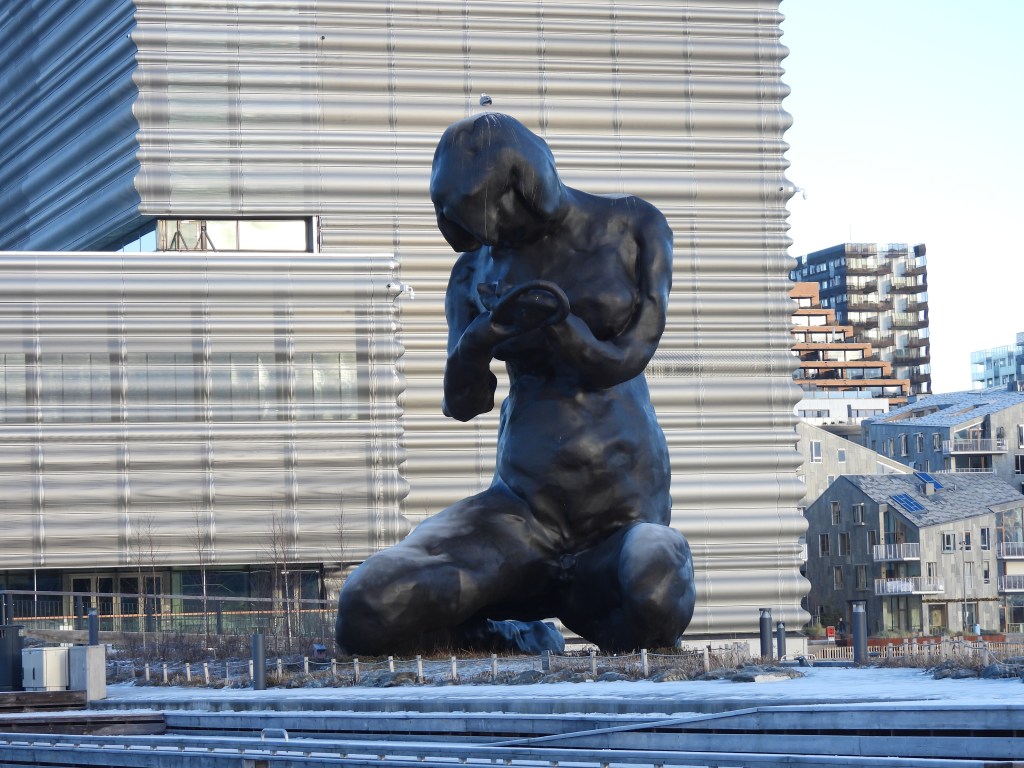
The Mother by Tracy Emin

The call of the wild

I’m in storied country. Fort Augustus at the edge of Loch Ness in the Scottish Highlands. The stones that line the shallows of the Loch, the trees dripping with lichen lace, the fir trees dressed green and warm for winter. Everything is steeped in myth and you can feel you’re walking ancient paths. It’s so beautiful.

We are staying at an old converted Monastery on the very southern shore of Loch Ness. Today we woke to see the mists rise off the water and settle around the crest of the hills that surround them. They’re not so tall as the mountains, we passed Ben Nevis on our way in, which was mountain country, snowy and rugged, with waterfalls at every turn and the high arched stone bridges you see in movies. Spectacular. There’s no snow yet on the hills around Loch Ness where we’re staying, they’re red with what I assume is heather and lined with the firs. The lichen is such a delicate pale green it’s nearly yellow, it frills everything that isn’t smothered in moss. We saw an apple tree dark with frost, it looked dead except for the russet apples still clinging to its branches. Like a spell had been cast. You wouldn’t be surprised to see a witch slink from the shadows nearby.

We haven’t ventured any further afield today than a short walk around the village. There are five locks on the canal that runs through town and a swing bridge that literally swings away from the road to let tall boats through. There was a ribbon of traffic winding through the whole town today waiting for the man working the bridge to signal for the closure to reconnect the bridge with the road. He did this, not via any technology though I’m sure there’s a lot involved, but with a clear shout that rang across the canals like a bell.

I stalked a robin near the boathouse. Hard to get a good shot, they move so fast. The birds look hardy. The deer stood still for me and the ‘hairy cows’ barely blinked in my direction.

I could stay here a while. I can feel it in my bones.

First star on the right, straight on till morning

I read Peter Pan for the first time when I was about eight years old. I won a paperback copy in a German language class exam at North Cottesloe Primary School circa 1974. Aside from counting from one to ten and being able to offer the observation, das is ein hund in a questionable accent should the need arise, the book was the only substantial impact learning German had on my life. But I was utterly transformed through the gift of reading that book.

I was mesmerised by the boy who could fly and who never grew up. I would do anything to join him. It felt very possible. Maimie, his first friend who appears in Peter Pan in Kensington Gardens and Wendy Darling, were long gone by now, I figured. Neverland was ripe for a Gillian. And if Peter wasn’t coming for me, I was prepared to go to him. Like most children of Irish Catholic heritage in my era would do, I began by praying to God to help me learn to fly.

I said prayers every night before I went to sleep. It was quite the convoluted process even without my aviation ambitions. I recited the Our Father, then the Hail Mary and followed that with a list of family and friends for God to bless if he happened to cast his Almighty eye their way in the night. You couldn’t be too careful. I did this mostly in order of personal preference, swapping mum and dad into first place on alternative nights to be fair, my sister in next and my cat, Tiddlywinks last because I wasn’t really sure how God felt about pets. At the end, I’d add a personal wish list that up until this moment consisted of anything from a pair of patent leather Mary-Janes in powder blue or Gloria and Dawn Paper Dolls exactly like the ones my friend Jenny Harvey got for her birthday.

Those minor desires were discarded forever once I discovered Peter Pan. I wanted to fly. To Neverland. To see fairies and lost boys, pirates and crocodiles and Indian princesses who wore fringed leather dresses and their hair in long black shiny plaits. Most of all to be friends with Peter. I knew the way there, from the helpful instructions supplied by Mr Barrie, first star on the right and straight on till morning. All I needed was a way to launch. Asking God to help out seemed a reasonable first step. I knew it was a big ask, so it came with a promise that if he would grant me this one wish, I would never bother him again. Mum, Dad and my sister and the cat could look after themselves.

Praying was only the start. I also practised on swings, which was the closest I could get to the feel of flying as I imagined it might be. I’m not really sure what I was aiming for, some kind of transcendental crossing of sorts, I guess. I’d swing as high as I could and while I was whizzing back and forth with no small amount of determination, I’d sing the words to the Peter Pan song from the Disney cartoon of the same name which, I took for some kind of incantation. I cringe so much to remember it now because I really put my heart into it. It went as follows…

Fly, fly to Never Neverland

You and I

To Never Neverland

No worries, no cares

Just fly everywhere

And you can live happily

I was oblivious to any audience I may have had on the ground, so focused was I on attracting the attention of a passing Peter or Tinkerbell. Who knows what the other kids waiting for their turn on the swing thought about it, but safe to say it’s a surprise I wasn’t beaten up more often.

I saved up my pocket money and spent it on small tubes of glitter available at the local shop for around 5 cents a vial. To my child’s eye, it looked like genuine fairy dust and even though it took all of my popsicle cash, I thought it was a fair bargain. I would arrange myself on the edge of our veranda, balancing precariously on the railing, scatter the contents over my head and leap off, the very picture of optimism. When I crashed to the ground, I was undeterred. I tried over and over in the hope that one of these pots of glittery gold would come through and I’d finally be borne aloft into the clouds and spirited away. I felt a twinge of guilt about poor mum and dad who would no doubt wonder where I’d gone, but children disappear in fairy tales all the time and adults get over it pretty fast so I wasn’t too concerned.

None of it worked. Eventually, I gave up and accepted my fate as a groundling. Most people would consider my efforts a failure because I never learned to fly. If that’s how you measure such aspirations, then yes, all I got was a reputation as an oddball, a twisted ankle, glitter that would never completely come out of my hair and a shortened sleep cycle because it took such a long time to get through my prayers. But I learned how to dream. And believe in magic. And once that belief is embedded deep, it sticks fast. It may be lost for a time, but it’s never all that far away.

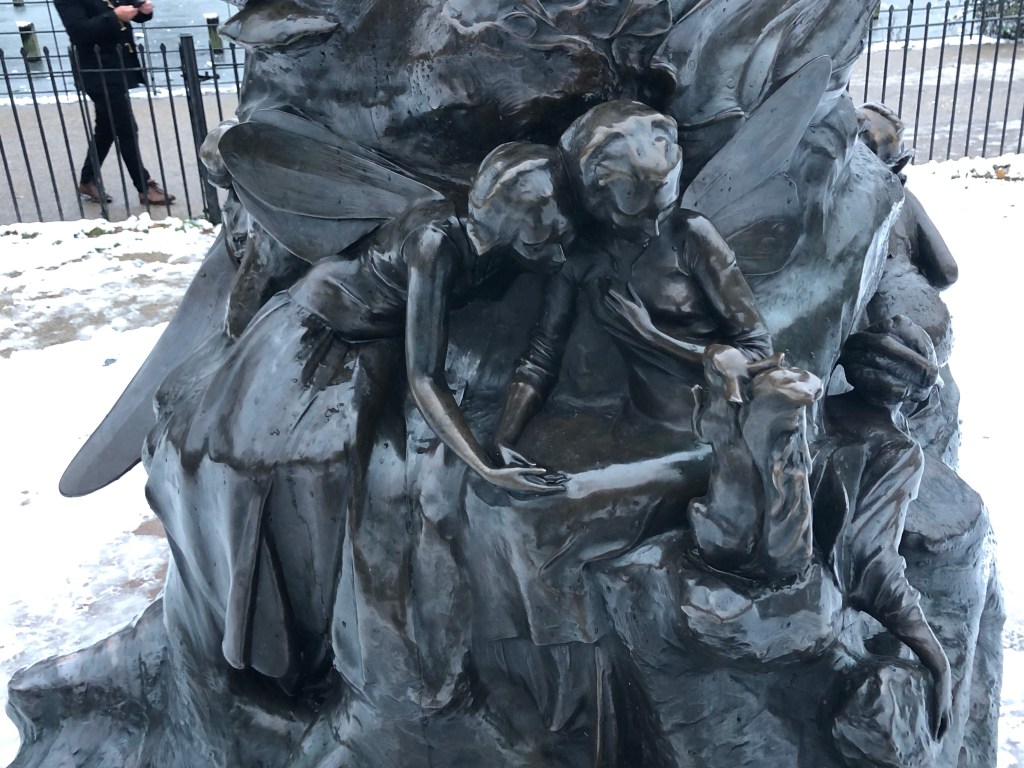
I found it again only yesterday in fact. My husband and I arrived in London for the start of six-month-long trip we have waited for, for a long time. There was a thick snowfall right across the city. Our hotel is on the doorstep of Hyde Park and the first thing we did was walk through to Kensington Gardens to find my holy grail. The statue of Peter Pan commissioned by J M Barrie in 1912. Kensington Gardens in the snow. It was magical. It was as beautiful as I imagined it would be.

There’s a moment in Peter Pan where he tells Wendy that fairies are born when a new baby laughs and every time a child says they don’t believe in fairies, somewhere a fairy dies. Near the end of the story when Tinkerbell herself lies dead, Peter in his grief brings her back to life with his longing and his conviction that she is real. It’s a beautiful literary moment when we are reminded of the power of belief.

If you are worried about the state of the world, or you stopped believing in fairies too many years ago to remember, you can be assured of this. There is power in magic and wonder, however you choose to find it. For me, it was waiting here in Kensington Gardens, just behind the big lake where the white swans glide. And the stories and dreams that have given me wings all of my life, saw a statue for the very first time and remembered.

I Miss our Dogs

I’m a well-known vampire. In my youth, I had a shot at fitting in with the cool crowd. This involved donning the smallest bikini I could squeeze my triple-a cup “breasts” into, slathering myself in reef oil, unfurling an alfoil reflector to aim at my face to increase the uv rays from blistering to radioactive and then laying out under a high white Australian sun until nicely browned. Except I didn’t brown. I turned a mottled purple, peeled like desiccated coconut and eventually reverted to a blinding shade of white that would rival the late Shane Warne’s smile.

I accepted my fate early on and went Goth instead. It was so much better for my complexion and I didn’t have to try to smile at boys. Even in the most sweltering of heat, I’d clad myself head to toe in black, including my well-soaped sticky hair which was teased into a Sideshow-Bobesque spiky cloud that doubled as a sunshade. I walked in shadows like the night all through my teens and subsequent decades thus avoiding for many years even a coy flutter of sun on the palest parts of my person.

Then my dog died.

I don’t know what you do when your dog dies. What are you supposed to do? Coping with death has happened before and it is not a case of practice making anything more than its own perfect kind of hell, frankly. I miss him so much. My husband is heartbroken. In the last two years, both of our beautiful dogs have left us and we are not ok. We have become a household without dogs, a soulless, grim, too-quiet affair without smelly beds and barking for no reason at odd hours, without grime marks on the wall or hair all over the sofa. Without the weight of a purposeful steady gaze at precisely five to four every day just before dinner. Without a wet nose pushing under our hands to artfully guide us into a pat, without the clatter of claws on the floorboards at night, without the scrape of a paw at the door to come in, seconds after we had let him out.

Our Huey sunk into a deep depression when his brother Jo went first a couple of years ago at 17. Huey aged quickly then, he slept a lot and struggled to walk any distance. But he still loved the beach, he still visibly perked when he saw us get into our bathers, he still erupted into the water like an arrow from a bow, he still swam in circles around my husband then rested in his arms in deep water, staring calmly into the blue as he had done every single swim since he was a puppy. He still dug for his ball or carried it into the shallows to drop it in water only to snatch it up, drop it and snatch it up again, over and over in a game only he understood. He still waited in studied nonchalance on the shore with his ball in his mouth, ever hopeful another dog might try to steal it away so he could thwart them with a clever feint and dodge. He still loved us. He still sat at my husband’s feet, gazing up at him, chin resting heavy on his knee or his foot in an enviable satisfaction with his lot in life.

When Huey got sick, it was fast. A terminal cancer. We made the terrible decision quickly, without too much doubt. We are both of the opinion if your dog has an incurable disease, is facing any prospect of suffering and you try to keep them alive then you really have to ask yourself who you’re trying to protect. But certainty doesn’t help. It doesn’t help. It doesn’t help the guilt, and it doesn’t stem the grief.

Both of our boys died in their later years, and I know we should be thankful. I know to nod or try to smile in agreement when someone well-meaning tells me he reached a good age or even sounds surprised he lived as long as he did. I feel so savage when I hear it. There is no good age. There is only his age. There is only his absence. There is only our grief.

We did not cope. First, we took ourselves across the country to inflict our sorry selves on friends celebrating significant events. A 50th birthday, a belated 50th birthday, a wedding. So much joy and our hearts were full for them. And these were real friends, who take you even, especially, when you’re broken. I’m glad we went, even if we weren’t great company. But you always have to come home, and that’s where the shadows lay in wait. We have been like dogs in pain ourselves since, turning in useless circles, pacing, restless, bewildered, snappy and impatient with each other and ourselves.

We have a lovely love though, even or especially when adrift. However wretched we might feel we can always fall back on this truth. It’s a love that allows for imperfection, it offers room for sorrow and all the various uncomfortable and ugly ways it can manifest. We tread softly when we need to. And we have needed to a lot. Often we have to stop and remind each other, but it’s been the spine of our love for such a long time now, once we remember, we find our way back to what matters pretty quickly. I am very grateful for that.

So, after a stretch of uncomfortable manifestations and no small amount of imperfections, one recent Saturday coincided with the first sunny day Perth had seen for some time. We’d had a long winter, bleak, grey, relentless rain. We had a couple of days with no commitments and the sun emerged, shyly and with perfect timing through cloud like a friend.

Gosh it felt like a long time since we’d had any fun. (Though in reality, we had a very good time at the aforementioned parties even if we did frighten the horses now and then.) We felt renewed, hopeful, like the light could wash us clean. Obviously, this called for champagne. And a lot of it.

Maybe it was the sun, maybe it was the company, maybe it was the three (or was it four) bottles of champagne. Who can say? But suddenly it seemed like the greatest idea in the world to whip off our dacks and sit there in our respective glory, listening to music, soaking up the rays. How we drank, how we laughed, how we cried, how we sang, how we barely ate a thing to soak up the booze, how we didn’t consider the precarious state of our grandchildren’s mental health should they arrive unexpectedly and come round the back. It was, insomuch as I remember, a wonderful, wonderful day.

It was not until the next morning when we woke with piercing headaches, my love arose to make me a coffee and I repaid this gesture of merciful devotion with a wild shriek of mirth. “You’re burnt,” I said, charged with the righteous confidence of one who is so sun-conscious and self-conscious, they never take off their neck-to-knee swimming costume or their wide-brimmed hat even in the dead of winter. “So are you,” he said in return, oily with the glee of one who is handed immediate and welcome revenge. Was I ever. The only parts of my skin spared the sear of the sun were the underside of the rolls of fat on my menopausal belly. I looked like a previously undiscovered species of striped sea slug.

A week or so later the blinding glare of the tomato hue has faded to an unattractive dull magenta and the stripes remain. But worth it. I am reminded there is joy in the ridiculous, peace to be found in speaking your heart aloud to someone who loves you, and that given that I am female, over 50 and invisible, I can wear what I like. Including nothing.

I still miss our dog. I miss our dog. I miss our dog. I love you my boy.

Getting started in short fiction

A beginner’s guide to writing, learning, publishing, entering flash fiction competitions and building your writing community.

About me

My name’s Gillian, I’m a journalist, writer and professional reader. I’m a submission editor for SmokeLong Quarterly. I love the genre of Flash fiction, it allows room to experiment, and to try new ideas without the huge commitment of attempting a novel and it demands very tight language. I have work in SmokeLong Quarterly, Splonk, Fractured Lit, Jellyfish Review, Reflex, Best Small Fictions 2023 and have been nominated for two Pushcart prizes.

If you’ve always wanted to try writing fiction but don’t know where to start, flash offers brilliant pathways for new writers and will hone the skills of even the most experienced authors. Famous writers in the genre include Pip Williams, George Saunders, Virginia Woolf, Lydia Davis and Ernest Hemingway.

What is Flash Fiction?

Flash fiction is generally accepted as being a short story under 1000 words. It’s an umbrella term for short fiction in general, so it’s also known as nano fiction, short fiction, short shorts, etc etc. Micro-fiction is stories under about 300 words.

Flash stories are complete narratives, so unlike prose poetry or vignettes which might describe a scene or a moment, flash has a beginning, a middle and an end. Even if the action is implied and a lot of the story happens off the page, flash is always telling a story. Good flash has conflict and a sense of urgency, so you’ll find it’s often ( but not always) written in present or even future tense. You’ll often hear the expression; start in the middle, in reference to flash. You’re looking to make an impact quickly, to offer stories that linger and to capture a glimpse of a rich and fully realised world that exists beyond the page.

The best way to get a sense of short fiction is to read it widely. There are some suggestions for starting points at the end of this article. Then, like ripples, they will lead you to more and more brilliant flash stories, journals and lovely people in the writing community.

Getting started

There are so many online resources for writing and publishing flash fiction. Try googling ‘flash fiction’ and you’ll be inundated. There’s so much. So, it’s a good idea to whittle them down into something manageable. There are some great courses you can pay for, but you’ll also find endless opportunities that don’t cost anything. A good craft newsletter is a goldmine of useful and free information.

Here is an excellent overview on how to write flash fiction from the author, editor and teacher, Matt Kendrick in Lucent Dreaming. And another, written by Kathy Fish for the prestigious Bridport Prize. And Bath Flash Fiction run rolling competitions and feature a series of excellent craft articles on the website.

SmokeLong Quarterly is one of the oldest and most prestigious flash journals in the world. It offers excellent courses run nearly all year round. SmokeLong Fitness runs from September 2023, and you can find more details about that and other courses on the website.

Kathy Fish’s workshops are highly sought after, and admittance is generally by lottery. They’re popular for a reason, she’s a brilliant teacher. Her free substack is full of great resources, including writing tips, craft essays, prompts and readings.

Tommy Dean is the Editor of Fractured Lit in the US, he runs workshops throughout the year. Check out his website. Here’s one starting in August 2023 or sign up for his free substack.

Retreat West is an online writing community, they do workshops, publish and hold really good competitions. You can join up for a fee or dip in and out of their free resources. Their monthly micro competition is a fun one to start with and it doesn’t cost a lot to have a crack.

If you’re in Perth (where I am based) and keen for some face-to-face action, Night Parrot Press (which is run by the brilliant Linda Martin and Laura Keenan) holds workshops for beginners and prints a flash anthology every year, plus they run the annual Flashing the Cover competition with Writing WA.

Competitions

Competitions are a fun way to put your work out there and potentially get published, either online or in a hard copy anthology. Even if you don’t make the winner’s list, they give you a focus to write, a word count, often a prompt, and a deadline, so a reason to stop tinkering and submit that sucker. That said there are a lot of dodgy dealers out there, so make sure you choose a reputable comp.

Be wary of competitions that cost too much to enter, ($20 is the top end of what you should expect to pay in my view and the prize money should match.) Many lit mags are run by volunteers and use income from competitions to keep afloat, so it can be a good way to support the writing community, but it’s ok to be wary. They will often have some free entries for those who can’t afford the entry fee so worth checking.

Lucent Dreaming via Betas and Bludgers has a very handy spreadsheet of available comps, inc. word count, prize money, deadlines and entry fees. You’ll find it here.

Books

The glorious hard copy book of craft advice is still one of my favourite resources. They’re few and far between in this genre though. There are a couple coming out soon, highly anticipated works by Kathy Fish and Tommy Dean.

Nancy Stohlman’s Going Short is contemporary and very comprehensive. (pub: Ad Hoc Fiction, 2020)

The Rose Metal Press Field Guide to Writing Flash Fiction: Tips from Editors, Teachers and Writers in the Field. (The Rose Metal Press, edited by Tara L Masih, 2009)

Unlocking the Novella-In Flash by Michael Loveday (pub: Ad Hoc fiction, 2022)

Submitting your stories

Most writers want to be published. It’s a joy. There are countless lit mags that specialise in flash fiction, some will pay for stories, some don’t. Be very wary of lit mags that ask you to pay a submission fee to have your work read. Make sure your work is as polished as it can be first, try to find someone you trust to read it for you, check it for errors and give you honest feedback. If you think your story is ready, don’t just send it to every journal out there. Look for one that you think is a good fit. You will know this by reading the publication first, to get a sense of the kind of work they publish.

Every good lit mag will have submission guidelines. Read these carefully. They will give you word limits, formatting guidelines, let you know if they pay, and other really important information you need to know. Many read blind for example so it’s important you don’t put your name on your story, it will be instantly rejected. Look for publications that offer respectful and professional communication, including, (especially) when it comes to rejections.

Don’t take rejections personally, they are much more common than acceptances and don’t argue. Be aware many publications can take several months to get back to you. Again, their guidelines will let you know. Always be professional and polite also. It’s a small community.

Like anything, it’s good to know if you’re submitting to a reputable journal. There are many. This list put together by author and editor of Flash Frog, Eric Scot Tryon is a wonderful start. As he says, it’s by no means exhaustive, but it will give you a good firing-off point to read and submit your own work.

Readings

This is such a small snapshot of the resources available. If you have any other suggestions, I’d love you to add them in the comments.

To finish off, here are a very few of my favourite examples of the genre. I will add to this list as more come to mind to build a collection of great work and fabulous journals, so check back. This is just a start. Again, if you have any suggestions, I’d love you to add them in the comments.

Company by Patricia Bidar in Atticus Review

Seven Minutes by Eric Scot Tryon in Longleaf Review

in ache by Melissa Llanes Brownlee in SmokeLong Quarterly

19 Owls by Elisabeth Ingram Wallace in The Forge Literary Magazine

Undergrowth by Melissa Bowers in SmokeLong Quarterly

I’m Vincent Van Gogh and I Painted That Way Because I knew it Would Look Really Sweet on a Mousepad by Audrey Burges in McSweeney’s

Collective Nouns for Humans in the Wild by Kathy Fish in Jellyfish Review

A Practical Guide to Making Rain by Myna Chang in The Citron Review

The Shoal by Jiksun Cheung, Wigleaf.

Sticks by George Saunders

The Cognitive Behavioural Therapist Wants a Divorce But Does Not Want To Be The One To Ask by Jo Withers in X-R-A-Y

Between the Nail and The Skin by Hema Nataraju in Janus Literary

The Diamond Factory by Helen Rye in Matchbook

Romans Chapter 1 Verse 29 and Crushing Big by Kit de Waal, Bridport Prize.

Chicago by Kathy Fish, in Wigleaf.

Black Annis by Matt Kendrick in New Flash Fiction Review.

How to Tell a Scary Story by Sara Hills in X-R-A-Y

Hold Pressure by Eliot Li in SmokeLong Quarterly

Alice, Some of the Time by Abbie Barker in Atlas and Alice

Seeing Ghosts at Bed, Bath and Beyond by Kristina T Saccone in Twin Pies Literary

Lawn and Garden by Timothy Boudreau in Monkeybicycle

Matzo by Kelle Clarke in Flash Frog

Thirteen Letters by Stephanie King in Ghost Parachute

‘DP Camp 713, Aschaffenburg, August 1948’ by Alexandra Otto in National Flash Flood

A Succession of Silences by Electra Rhodes in Books, Ireland Magazine